


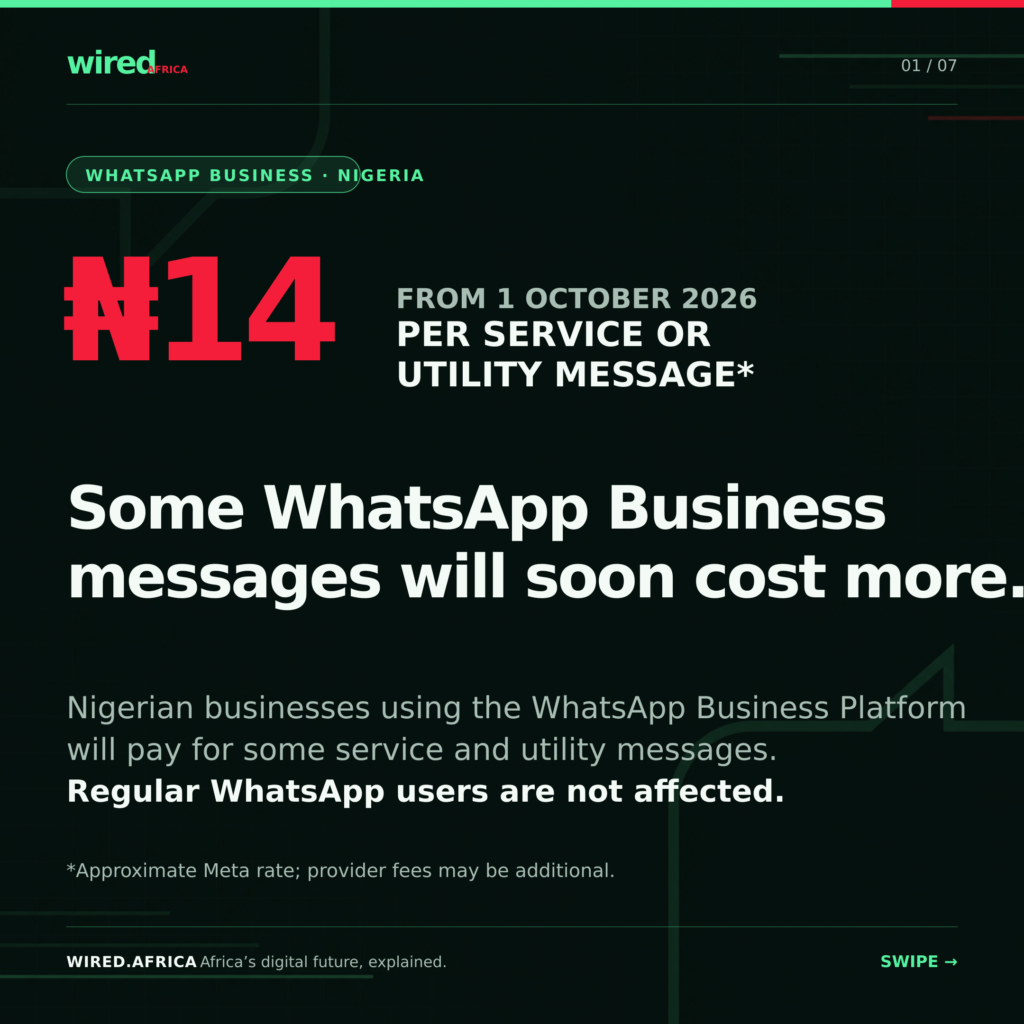
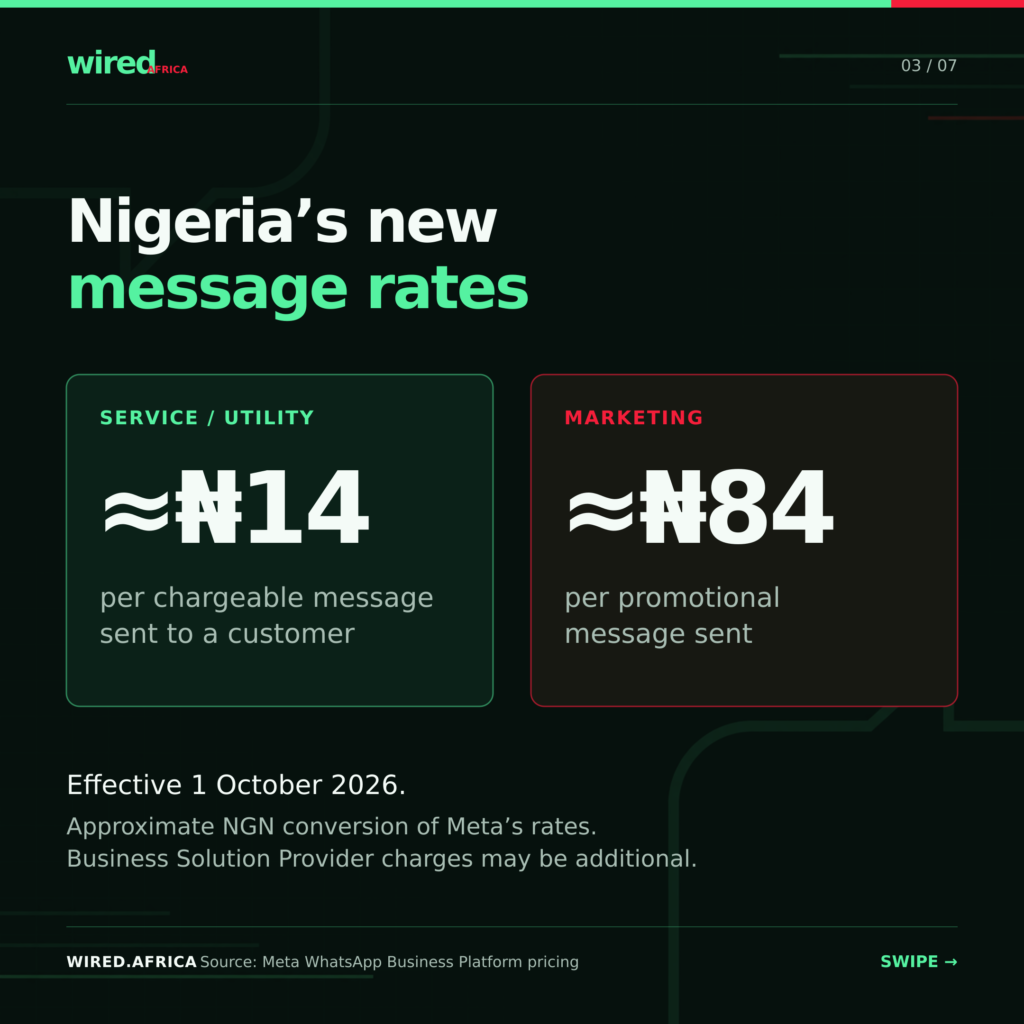
From October 1, 2026, Meta will charge roughly ₦14 (about $0.0101) for each chargeable utility or in-window service message sent to a Nigerian WhatsApp number, and roughly ₦84 (about $0.062) for each marketing message. Both figures are Meta’s own rate-card conversions, reported by Techpoint Africa. The rest of this piece explains where that ₦14 figure comes from, why it applies to messages that used to be free, and what it actually means for a business budget.
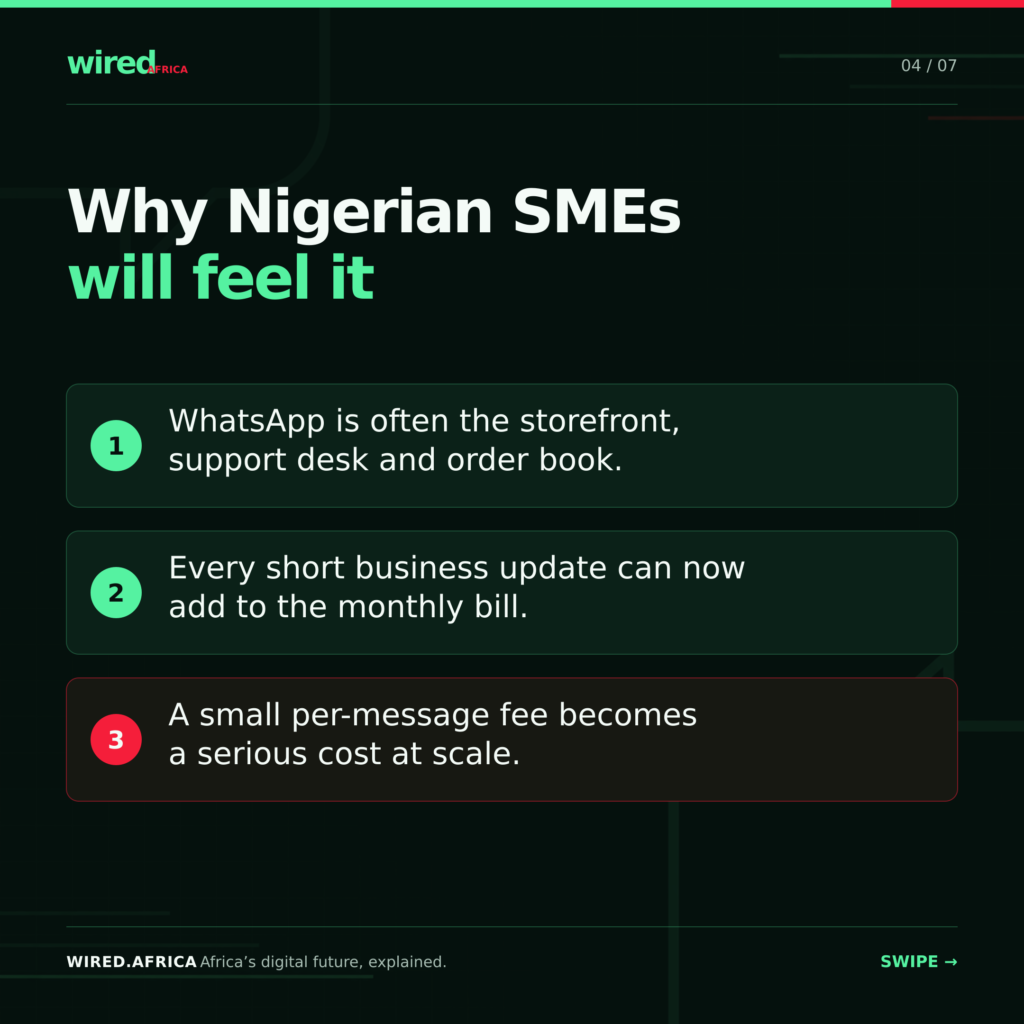
For years, WhatsApp’s appeal to small businesses across Africa came down to one simple fact: it was free, or close enough to it, and everyone was already on it. That calculation has been changing in stages since mid-2025, and the next stage lands on October 1, 2026, when Meta starts charging for message types that have been free since November 2024. In Nigeria specifically, that means a business will pay about ₦14 for every chargeable utility or service reply it sends inside a customer conversation — a message that costs nothing today. For African small and medium enterprises that run their entire customer relationship through a chat window — order confirmations, delivery updates, support replies, payment reminders — the shift is not cosmetic. It changes the unit economics of a channel that, for many businesses, is not a marketing add-on but the whole storefront.
This piece breaks down what has actually changed, what the numbers look like across Nigeria, Kenya, South Africa and Egypt compared with wealthier markets, and why a rate that looks cheap in dollar terms can still land hard on a business operating in an economy where the minimum wage is under $50 a month.
A Quick Recap: What Actually Changed, and When
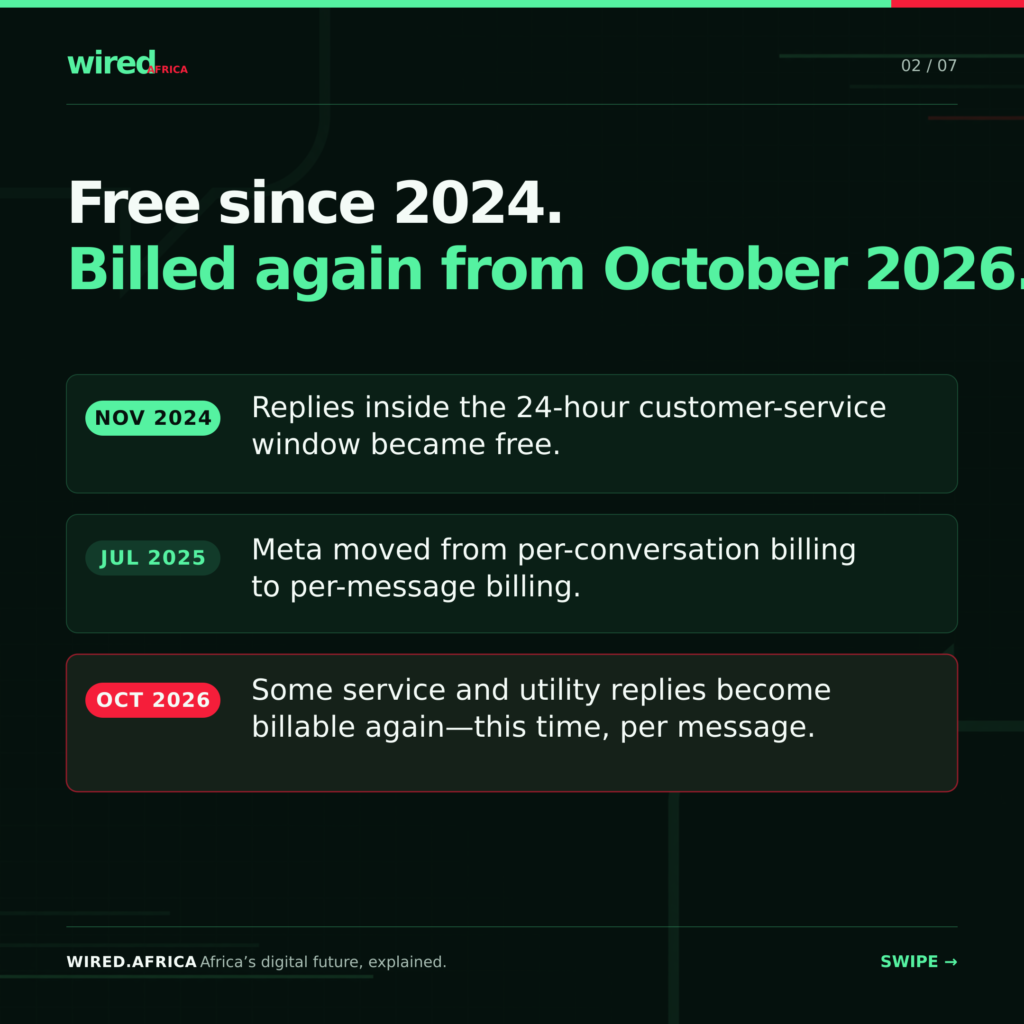
WhatsApp’s business pricing has moved through three distinct phases in under two years. Each one shifted what businesses are billed for, not just how much.
| Date | What changed |
| November 1, 2024 | Customer-service replies inside the 24-hour window became free on the WhatsApp Business API — a cost-saving move at the time. |
| July 1, 2025 | Meta replaced conversation-based billing with per-message billing. Instead of paying once for a 24-hour window regardless of volume, businesses are now billed for every individual marketing, utility, or authentication template delivered. |
| October 1, 2026 | Service messages and in-window utility messages — free since November 2024 — become chargeable again. Meta’s own documentation gives an example: a support exchange containing one marketing template, two AI replies, one agent reply and one order confirmation cost 1 billed message before August 2026, 3 from August 1, 2026, and 5 from October 1, 2026 onward. |
In plain terms: the 24-hour customer-service window still exists and still opens the same way, when a customer messages a business first. What has changed is its job. It used to be the billing unit itself. Now it mostly determines which messages are free, and that list of free messages is shrinking.
How WhatsApp Business Pricing Actually Works
The mechanics matter here, because a lot of confusion among small business owners comes from conflating three different products.
1. The free WhatsApp Business App is not affected
Manual replies typed by a person using the free WhatsApp Business App or WhatsApp Web remain free, with no per-message or per-conversation charge. The pricing changes discussed in this article apply only to the WhatsApp Business Platform — the Cloud API and the older on-premise API — which businesses use for automation, bulk messaging, chatbots, and CRM integrations.
2. Messages are billed by category
- Marketing — promotions, offers, campaign messages. The most expensive category, with no volume discount.
- Utility — order confirmations, shipping updates, appointment reminders, billing notices. Cheaper than marketing, with volume-based discounts at scale.
- Authentication — one-time passwords (OTPs) and verification codes. Priced similarly to utility messages, with a notably higher ‘authentication-international’ rate in some markets, including Nigeria.
- Service — free-form replies sent by a business inside an open 24-hour window, triggered by the customer messaging first.
3. The rate depends on the recipient’s country, not the business’s
A business based in Lagos sending a marketing template to a customer in Lagos pays Nigeria’s rate. The same business messaging a diaspora customer in London pays the UK rate. This catches out businesses with cross-border customer bases, including the many African e-commerce and remittance-adjacent SMEs serving diaspora communities.
4. Most businesses pay a markup on top of Meta’s base rate
Few small businesses connect to Meta’s API directly. Most go through a Business Solution Provider (BSP) — companies like Twilio, 360dialog, WATI, or Nigerian providers such as Termii — who resell API access. Some BSPs pass Meta’s rate through at cost and charge a flat monthly platform fee instead; others add a small per-message markup, commonly $0.003–$0.01, on every message sent and received. This second layer of cost is easy to overlook when comparing ‘WhatsApp’s price’ in isolation.
5. Nigeria’s authentication-international trap
Nigeria is one of a short list of markets — alongside Egypt, India, Indonesia, Pakistan, Saudi Arabia, South Africa and the UAE — where a much higher rate applies to authentication messages sent from a WhatsApp Business Account registered outside that country. In Nigeria’s case, that international authentication rate runs to roughly eleven times the domestic authentication rate. A Nigerian fintech or e-commerce platform whose OTP infrastructure is registered abroad — not unusual for startups built on foreign-hosted stacks — can end up paying substantially more per verification code than a locally registered competitor sending the identical message.
What It Costs: Africa Against the Global Table
Meta’s base per-message rates (before any BSP markup) show a pattern that surprises a lot of people: Africa is not the most expensive region in nominal dollar terms. The rates below are for marketing messages and for the utility/service messages becoming chargeable inside the service window from October 1, 2026.
| Market | Marketing (per message) | Utility / in-window service (from Oct 1, 2026) |
| Nigeria | $0.062 (≈ ₦84) | $0.0101 (≈ ₦14) |
| Kenya | $0.0248 (≈ KSh 3.3) | $0.0044 (≈ KSh 0.57) |
| South Africa | $0.0379* | $0.0076 |
| Egypt | $0.0773 (≈ E£4.1) | $0.0054 (≈ E£0.28) |
| India | $0.0118 | $0.0014 |
| United States / Canada | $0.025 | $0.0034 |
| United Kingdom | $0.0635 | $0.022 |
| Germany | $0.1365 | $0.055 |
Nigeria, Kenya, and Egypt figures are Meta’s rate-card conversions to local currency as reported by Techpoint Africa on the October 2026 update. *South Africa’s local-currency conversion varied noticeably between sources at the time of writing; the dollar figure shown is the one corroborated across multiple independent rate trackers — confirm directly with your BSP before budgeting off it. BSP markups are layered on top of all figures above and vary by provider.
For a Nigerian SME, the ₦14 figure is the one to budget around if your WhatsApp use is mostly support and order-status replies. The ₦84 figure is the one that matters if you run outbound promotional campaigns — and it is nearly six times higher, which is exactly why keeping marketing and utility messages correctly classified (covered below) is not just a compliance detail but a real cost decision.
Read the table quickly and the story looks reassuring: Nigeria’s marketing rate is a fraction of Germany’s, and Kenya’s is among the cheapest in the world. That comparison is true and also misleading, because it compares prices without comparing what those prices mean relative to what a business in each country actually earns.
Why ‘Cheaper’ Doesn’t Mean Affordable: Africa’s Purchasing-Power Problem
Nigeria’s national minimum wage has stood at ₦70,000 per month since the National Minimum Wage (Amendment) Act 2024, unchanged through 2026. At prevailing exchange rates, that is roughly $42–45 a month, and a large share of the workforce — the National Bureau of Statistics puts more than 80% of Nigerian employment in the informal sector — earns at or below that line, since the wage law technically exempts employers with fewer than 25 staff. Most WhatsApp-run micro and small businesses fall squarely into that informal, exempt category.
Put a real number against that. A Nigerian SME sending 10,000 marketing messages a month — a modest volume for a retailer running a monthly promotion to its customer list — pays roughly $620 (about ₦840,000) in Meta’s base fees alone at the ₦84-per-message marketing rate, before any BSP markup. That single campaign costs nearly twelve times the national monthly minimum wage. The same calculation in Germany, at $0.1365 per message, comes to about $1,365 for the same volume — nominally more than double Nigeria’s cost, but against a German minimum wage of several thousand euros a month, it barely registers as a fraction of one worker’s pay. The dollar price is higher in Germany. The relative burden is lower.
Utility and service messaging tells a similar story at a smaller scale, and it is the more immediate concern for most WhatsApp-dependent SMEs, since it covers the routine back-and-forth of running a business rather than occasional campaigns. Nigeria’s post-October rate of roughly ₦14 per message means 500 order-status updates a month — routine volume for a small delivery or e-commerce operation — costs about ₦7,000 (roughly $5) in fees that did not exist before. That is a small number in isolation. It is also a cost that simply did not appear on last year’s budget, layered onto a business already absorbing naira depreciation and inflation running above 30% in recent years, and it scales fast for any business whose support volume runs into the thousands rather than the hundreds.
The Affordability Problem Runs Deeper Than the Bill
The purchasing-power gap does not stop at the business owner’s side of the chat. It extends to the customers on the other end. According to GSMA’s research on smartphone adoption in Africa, an entry-level internet-enabled handset costs roughly 26% of average monthly income across the continent, and for the poorest 40% of the population, that share climbs to as much as 73% of monthly income. GSMA’s broader Mobile Economy Africa reporting puts the scale of the problem starkly: 63% of Africans remain offline despite mobile broadband coverage reaching most of the continent, not because of missing infrastructure but because of what devices and data cost relative to what people earn.
That matters for a WhatsApp-dependent SME in two directions at once. The business itself is likely operating on thin margins in a high-inflation economy, and a meaningful share of its potential customer base is either device-constrained, data-constrained, or both. When WhatsApp becomes a more metered channel for the business side too, it tightens a channel that was already stretched thin on both ends.
It is also worth sizing how central WhatsApp has become to African commerce before assuming a business can simply switch channels. Nigeria has more WhatsApp Business App downloads than any other African market, and across the continent MSMEs frequently run their entire operation — sales, support, and informal payments coordination — through chat rather than a website or a point-of-sale system, because chat was free and universally installed. Small and medium enterprises made up 37.2% of the global WhatsApp Business Messaging Platform market in 2025 and are its fastest-growing segment, expanding at close to double the rate of large enterprises. Yet the Middle East and Africa region together accounted for only about 4.7% of that same market’s global revenue in the same year — a region that is disproportionately reliant on the tool but represents a small slice of the commercial relationship, which also means comparatively little pricing leverage when global rate cards change.
What Gets More Expensive on October 1, 2026 — In Practice
Three categories of African SME are most exposed by the October update specifically, because their WhatsApp usage skews heavily toward the message types losing their free status:
- Delivery, logistics and e-commerce businesses that send automated order-status and dispatch updates inside an open customer window — previously free, now billed per message.
- Customer support teams and chatbot deployments that reply to inbound queries inside the 24-hour window — the exact use case that became free in November 2024 and now reverts to a per-message charge.
- Fintechs and platforms sending authentication codes from accounts registered outside the customer’s country, exposed to the steep international-authentication rate described above.
Businesses whose WhatsApp use is mostly customer-initiated support, rather than outbound marketing blasts, may not have felt much cost pressure through 2025. The October 2026 change closes that gap — it specifically targets the service and in-window utility traffic that support-heavy SMEs generate.
WhatsApp to Charge ₦14 Per Message: What African SMEs Can Actually Do About It
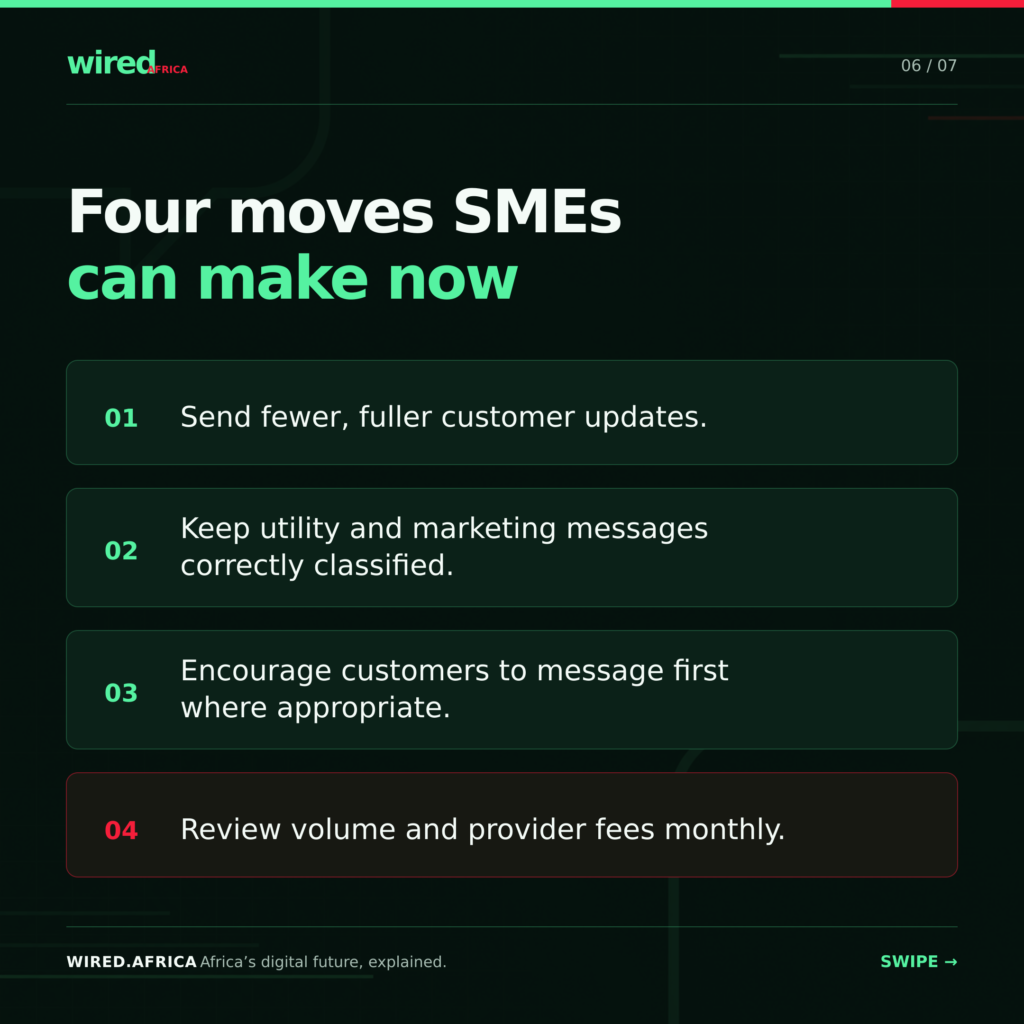
None of this makes WhatsApp unaffordable outright, but it does mean treating it as a paid channel with its own cost discipline, the way a business would treat SMS or paid ads, rather than as free infrastructure. A few concrete adjustments help:
- Consolidate replies. Bundle information into fewer, well-structured messages instead of a back-and-forth stream of short utility pings — each one is a separate billable event from October 2026 onward. WhatsApp Flows and structured menus can capture several pieces of customer information in a single exchange.
- Keep marketing and utility strictly separate. Promotional content routed through a utility template is both a policy risk and, once flagged, the costliest category by far. Classify templates correctly from the start.
- Compare how your BSP charges before comparing what WhatsApp charges. A flat monthly platform fee with Meta’s rate passed through at cost is often cheaper than a small per-message markup once volume climbs past a few thousand messages a month — run the comparison for your actual volume rather than assuming either model is universally better.
- Encourage customers to message first. A service window opened by the customer avoids the marketing/utility template charge entirely for the reply that follows. QR codes, ‘chat with us’ links on receipts, and click-to-WhatsApp ads (which currently carry a 72-hour free messaging window for the resulting conversation) are ways to shift volume into that lower-cost path.
- Track your message-category mix monthly. Treat cost-per-conversation as a real metric, the same way a business would track cost-per-acquisition on any other paid channel, rather than discovering the total at the end of the month.
- For OTP-heavy platforms, check where your WhatsApp Business Account is registered. Nigerian and other exposed-market businesses paying the international authentication rate unnecessarily, simply because their account was set up abroad, can often correct this with their BSP.
The Bigger Picture
It’s worth being fair to the underlying economics here: this is a global repricing, not a policy aimed at Africa. The same shift from free customer-service messaging to per-message billing is landing on businesses in every market Meta operates in, and it follows Meta’s paid-subscription rollout for WhatsApp, Instagram and Facebook, a broader push across the company’s apps to build revenue beyond advertising. Running free infrastructure at global scale has a real cost, and businesses everywhere are being asked to absorb a slice of it.
What makes the African case distinct is the combination of three things landing at once: near-total dependence on WhatsApp as core business infrastructure rather than one channel among several, a large informal-economy SME base with thin margins and little cushion for new costs, and a purchasing-power gap that turns a modest dollar figure into a disproportionate share of income. The same pattern shows up in wired.africa’s analysis of WhatsApp usernames and what Nigeria should watch for — platform decisions made at global scale tend to reach African markets with local specifics that get worked out after the fact, rather than built in from the start.
The connectivity side of this compounds it further. the real cost of Nigeria’s internet infrastructure gap is its own ongoing story, and for SMEs weighing their options, comparing ISPs serving Nigerian businesses is a reasonable place to start, since a rising WhatsApp bill is only one line item in the total cost of simply staying online. No continent-specific relief mechanism or discounted SME tier has been announced by Meta as of this writing. Whether one emerges, and whether African governments or BSPs step in with alternatives, is worth watching over the coming months — alongside how subscription monetisation is reshaping Meta’s other apps, which points to a consistent direction of travel across the company’s products.
For deeper ongoing coverage of what these shifts mean for African businesses, see wired.africa’s Fintech coverage, wired.africa’s Digital Economy desk, and wired.africa’s Telecoms coverage.
Frequently Asked Questions
Why is WhatsApp charging ₦14 per message in Nigeria?
₦14 (about $0.0101) is Meta’s converted rate for a single chargeable utility or in-window service message sent to a Nigerian WhatsApp number, effective October 1, 2026. It applies to message types — order updates, appointment reminders, and support replies sent inside an already-open conversation — that have been free since November 2024. It is not a new tax or a Nigeria-specific penalty; it is Nigeria’s local-currency conversion of a global per-message rate that Meta is extending to a wider set of message categories worldwide.
When did WhatsApp start charging businesses per message?
Meta replaced its conversation-based billing model with per-message billing on July 1, 2025. Before that date, businesses paid once per 24-hour conversation window regardless of how many template messages it contained.
Is WhatsApp still free for personal use?
Yes. None of these changes affect personal WhatsApp accounts or the free WhatsApp Business App used for manual, non-automated replies. The charges apply specifically to the WhatsApp Business Platform (Cloud API and on-premise API) used for automated and bulk business messaging.
What changes on October 1, 2026?
Service messages and utility messages sent by a business inside an already-open 24-hour customer-service window — free since November 2024 — become billable again, priced per message by category and recipient country. In Nigeria that works out to roughly ₦14 per message for this category.
How much does a WhatsApp marketing message cost in Nigeria, Kenya, and South Africa?
As of the current rate card, marketing messages cost approximately ₦84 (about $0.062) per message in Nigeria, KSh 3.3 (about $0.0248) in Kenya, and around $0.0379 in South Africa, before any markup from a Business Solution Provider.
Can a small business avoid WhatsApp Business API charges entirely?
A business using only the free WhatsApp Business App for manual replies pays nothing per message. Charges apply once a business moves to the API for automation, bulk sends, or chatbot-driven support — which is where most growing SMEs eventually land as volume outpaces what one person can type manually.
What is the difference between the WhatsApp Business App and the WhatsApp Business API?
The App is a free, single-device (or limited multi-device) tool for small operations handling messages manually. The API (Cloud or on-premise) is built for automation, integrations, and higher volume, and is where the per-message pricing discussed in this article applies.

The WIRED.Africa's Press Desk delivers breaking news, official announcements, and timely updates on technology, business, innovation, and digital policy. Stories published under this byline are produced through the collaborative efforts of the editorial team and trusted news sources.


