AI Has a New Rival, and It’s Spelled With Just One Different Letter. Walk into any tech meetup in Lagos, Nairobi or Cape Town today and someone is talking about artificial intelligence. Chatbots answer customer queries for banks, farmers get planting advice by SMS, and students lean on tools like the ones in our guide to using ChatGPT to get through assignments faster. But increasingly, a second term is showing up in AI research circles and tech-philosophy debates: Synthetic Intelligence, or SI. It sounds like marketing spin — another rebrand of the same buzzword. It isn’t. The distinction is old, deliberate, and increasingly relevant to how Africa should think about the machines it’s building its digital economy on.
This piece breaks the two terms down in plain language, explains where the idea of “synthetic” intelligence actually comes from, and looks at why the debate has real stakes for African startups, policymakers, and workers.
What Is Artificial Intelligence, Really?
Artificial Intelligence is the umbrella term for machines trained to perform tasks that normally require human thinking: recognising a face, translating a sentence, flagging a fraudulent transaction, or recommending the next video. Modern AI systems, including the large language models behind tools covered in our best AI tools for students in Nigeria roundup, work by learning statistical patterns from enormous datasets. They get remarkably good at producing the right-looking output without possessing anything most philosophers would call understanding.
That’s not a knock on AI’s usefulness. Pattern-matching at scale is exactly what makes it valuable for fraud detection, logistics routing, and the vibe coding tools increasingly used by African developers to ship software faster. The word “artificial,” though, was chosen deliberately back in 1956: it signals imitation, not the real thing.
Enter Synthetic Intelligence: A 40-Year-Old Idea Getting New Attention
The term “synthetic intelligence” isn’t new marketing — it dates back to philosopher John Haugeland’s 1985 book Artificial Intelligence: The Very Idea. Haugeland argued that “artificial” wrongly implies fakery, and proposed a sharper analogy: the difference between a simulated diamond and a synthetic diamond. A cubic zirconia looks like a diamond but is chemically a different substance — a simulation. A synthetic diamond, by contrast, is grown in a lab rather than mined from the earth, but it is molecularly, chemically, physically a real diamond. Nobody would call it fake.
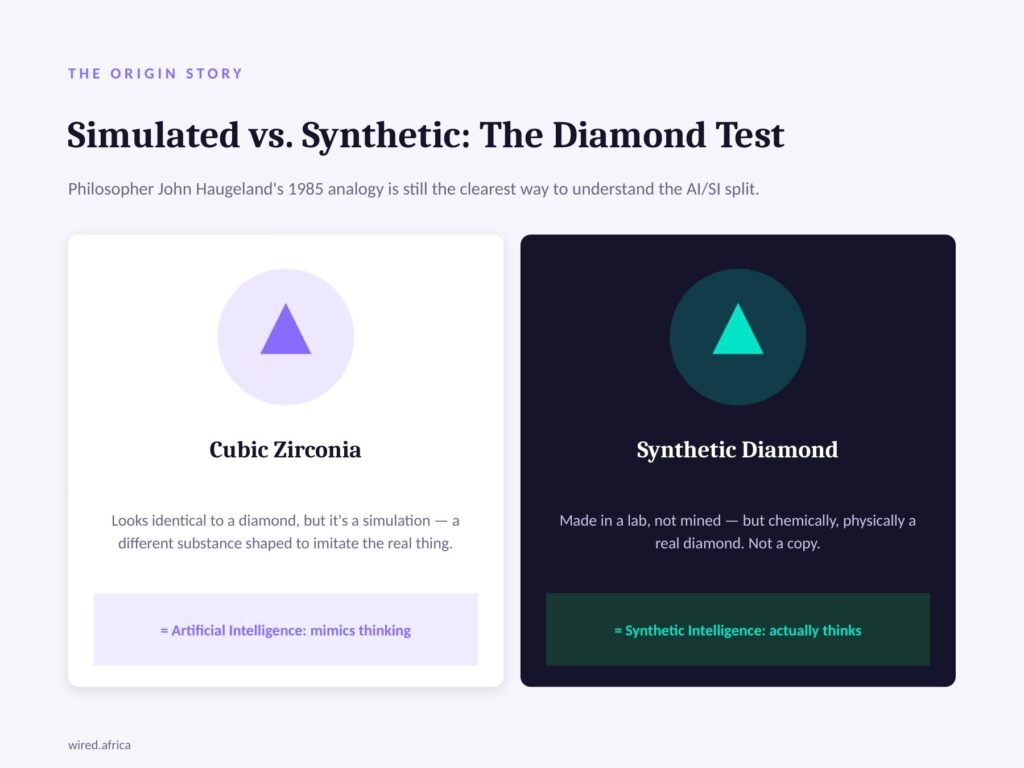
Applied to machines, Synthetic Intelligence describes a system that doesn’t just imitate human cognitive behaviour but genuinely thinks and reasons — just built from silicon rather than neurons. Where AI performs intelligence, SI would possess it, the same way a synthetic diamond possesses the actual properties of a diamond instead of merely looking like one.
Crucially, SI in this sense is still largely theoretical. No system deployed today — including the most advanced models discussed at events like the recent AI Summit Nigeria — is widely accepted by researchers as genuinely “thinking” in the way SI describes. The term is a marker for where the field might be headed, and a useful lens for cutting through hype.
AI vs SI: The Key Differences at a Glance
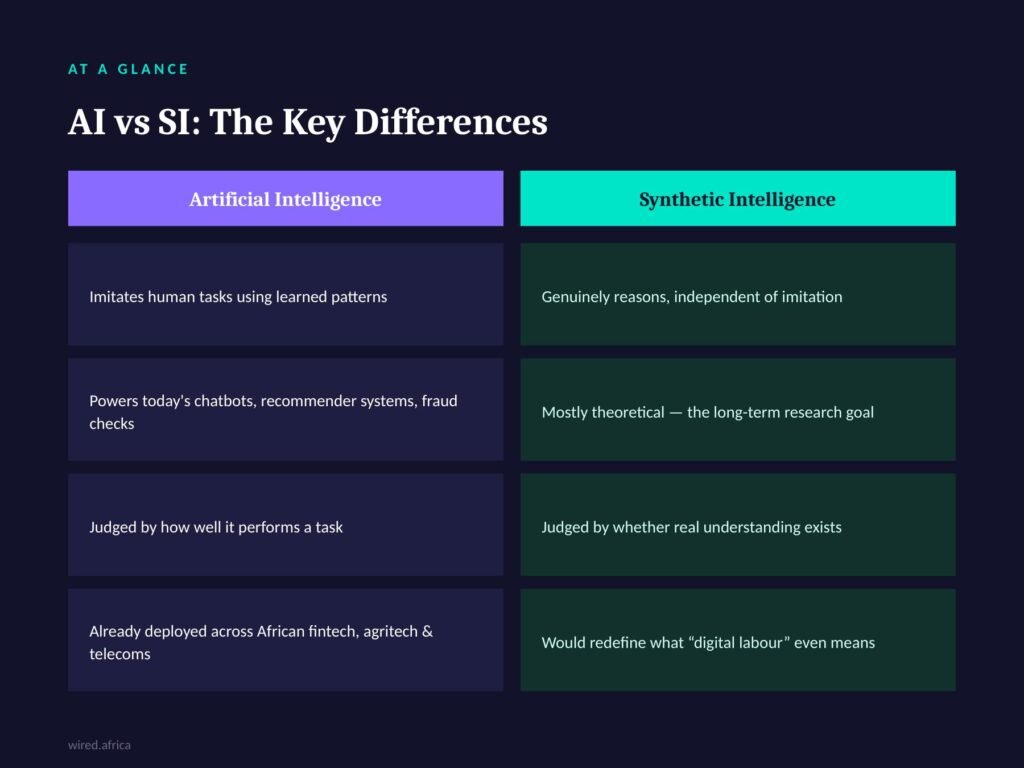
In short:
- AI imitates intelligent behaviour by learning from data. SI would genuinely reason, independent of imitation.
- AI already powers chatbots, credit scoring, and recommendation engines across African fintech and telecoms. SI remains a research horizon, not a product category.
- AI is judged by task performance — did it get the answer right? SI would be judged by whether real understanding exists underneath the answer.
Why This Debate Matters for Africa
It would be easy to file this under “academic philosophy” and move on. But the AI/SI distinction has practical stakes for a continent that is adopting AI faster than it is regulating or fully understanding it.
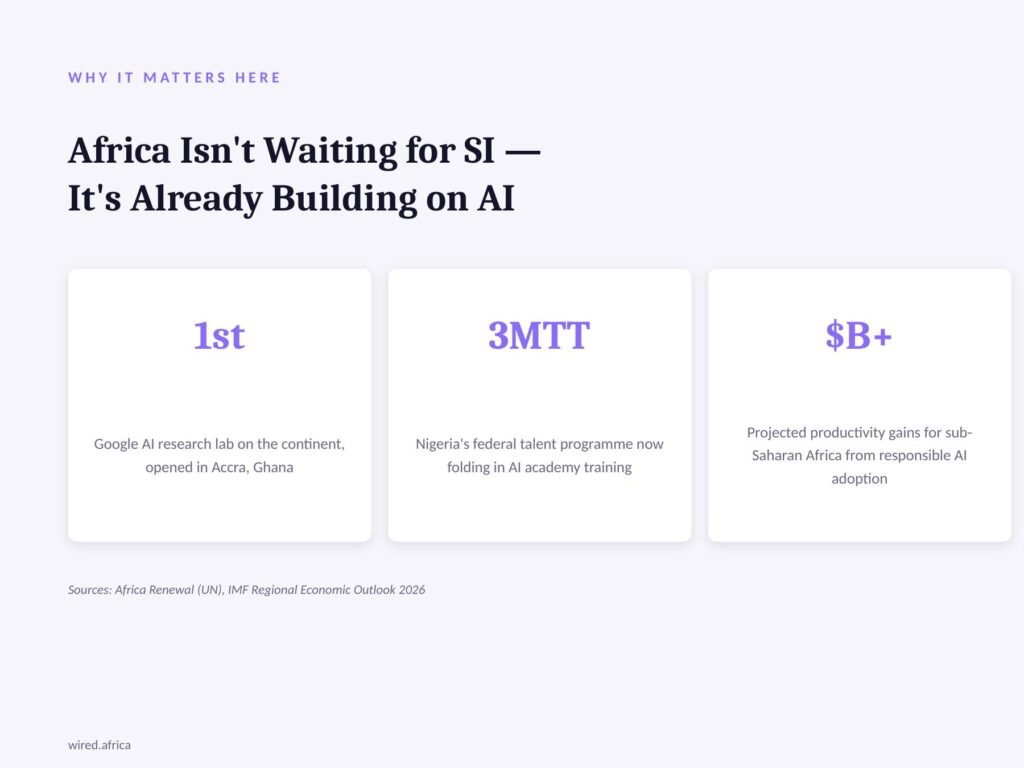
Google opened its first African AI research centre in Accra, Ghana, and organisations like UNESCO have flagged AI adoption as a continental priority. In Nigeria, government-backed programmes are already folding AI training into digital-skills pipelines — see our coverage of Meta’s AI Academy partnership with 3MTT and RAIN. Remote-work platforms are also opening up new AI-adjacent jobs for African talent, from data labelling to model evaluation.
The IMF’s 2026 outlook on the region argues AI could meaningfully boost productivity across agriculture, education, and public services in sub-Saharan Africa — but only current-generation AI: pattern-matching tools solving narrow, well-defined problems. None of the projected gains depend on machines achieving genuine synthetic understanding. That’s worth remembering the next time a pitch deck promises “real thinking machines” for a problem a simpler system could already solve.
Understanding the difference protects African buyers, regulators, and job-seekers from two opposite mistakes: dismissing today’s AI as “just autocomplete” and therefore underinvesting in it, or overestimating what current systems can actually do because a vendor borrowed the language of genuine machine cognition to sell a narrower product.
Deepening the Groove: The Physical Infrastructure Powering the Shift to SI
The Practical Pipeline
How Next-Gen Hardware, Wetware, and World Models are Dragging Machine Cognition Out of the Textbook and Into the Real World
Accepting that Artificial Intelligence is an imitation and Synthetic Intelligence is a genuine, non-biological realization of thought is only the first step. The more urgent question for the global digital economy is simple: where is this theoretical “synthetic diamond” actually being manufactured?
As tech labs hit the limits of what statistical pattern-matching can achieve, the transition from AI to SI is moving out of academic philosophy departments and into silicon foundries, robotics labs, and biotechnology facilities.
Here is how engineers are actively constructing the foundational layers of genuine, autonomous machine reasoning.
1. Overcoming the “Data Wall” with Self-Correction
Modern AI models are rapidly running out of high-quality human text to scrape from the internet. To break through this barrier, developers are abandoning the imitation model entirely and building autonomous reasoners.
Instead of feeding a machine pre-written answers, labs are deploying self-taught training frameworks. The system is programmed with nothing but the absolute foundational rules of math and logic. It is then left to invent its own problems, attempt to solve them, critique its own logical missteps, and autonomously rewrite its code to improve. Because the machine generates its own cognitive pathways rather than mimicking a human template, the resulting reasoning is entirely independent, self-generated, and synthetic.
2. From Text Generation to Physical “World Models”
An AI chatbot knows that an object falls when dropped because it has read that sequence of words millions of times, but it possesses no actual concept of gravity. To build genuine understanding, researchers are developing 3D World Models.
These frameworks process massive pipelines of spatial, physics-based, and industrial robotic data. The goal is to give the machine an internal, synthesized understanding of geometry, weight, and causality. When a robot powered by a world model encounters an obstacle it has never seen before, it does not fail due to a lack of training data. Instead, it reasons its way through the physical space using its engineered understanding of how the real world operates.
3. Brain-Inspired Hardware: Neuromorphic Chips
You cannot easily run a genuinely autonomous mind on standard computer processors. Traditional chips waste massive amounts of time and energy moving data back and forth between separate memory units and processing cores.
To solve this, hardware engineers are manufacturing neuromorphic computing chips designed to mimic the physical structure of biological brains. Intel’s Hala Point system, for instance, utilizes over 1.15 billion artificial neurons to test how brain-like architectures can process complex, real-time workloads using a fraction of the power of a standard server farm. Concurrently, semiconductor startups like Innatera are commercializing smaller neuromorphic microcontrollers. These chips use spiking neural networks to process sensory data directly on edge devices, allowing remote tools to listen, see, and adapt with independent, always-on awareness.
4. Biological Wetware: Living Silicon
Perhaps the most radical leap toward a non-simulated form of intelligence is happening where biology meets hardware. Biotechnology firms like Cortical Labs are actively building wetware computing systems.
These systems take live biological neurons grown in a laboratory dish and integrate them directly onto digital silicon chips. By sending electrical signals back and forth, researchers have successfully trained these living, hybrid networks to complete tasks like playing digital arcade games. It serves as a stark reminder that engineered intelligence does not have to remain entirely virtual; it can be built out of the very organic tissue that defines natural cognition.
The Next Steps for a Digital Economy
For builders, buyers, and regulators navigating this landscape, tracking these developments is crucial. The tools entering the pipeline over the next decade will not just look up answers in a database or guess the next word in a sentence. They will actively compute, adapt, and reason through unfamiliar environments in real time. Understanding where this hardware and software are actually being manufactured is what separates speculative tech hype from the tangible infrastructure of the next digital wave.
Beyond AI: Is Africa Should Prepared For What’s Coming?
Artificial Intelligence is what Africa is building its digital economy on today: useful, narrow, pattern-based systems already reshaping fintech, agritech, and telecoms. Synthetic Intelligence is the bigger, more philosophically loaded idea — genuine, non-biological thinking — that remains mostly theoretical. Keeping the two apart isn’t pedantry; it’s the difference between evaluating a technology on what it actually does and getting swept up in what it’s merely named.
For more explainers on the technology shaping the continent, explore WIRED Africa’s Future & Innovation section and our dedicated AI coverage.

The WIRED.Africa's Press Desk delivers breaking news, official announcements, and timely updates on technology, business, innovation, and digital policy. Stories published under this byline are produced through the collaborative efforts of the editorial team and trusted news sources.