




It is 10 a.m. on a weekday in Lagos, and a small business owner is stuck in traffic on the way to collect a signed contract from a client’s office in Victoria Island. She could send an employee instead, but that means pulling someone off actual work for half a day, if the roads cooperate. She could ask a friend, but her friend has their own version of this morning happening somewhere else in the city.
It isn’t a dramatic problem. It’s a small one, the kind that barely registers as a complaint on its own. But multiply it across millions of Nigerians doing versions of the same thing every week, and you start to see something bigger: a country that has digitised how money moves while leaving how tasks get done more or less untouched.
You can transfer money in seconds. You can order food from an app and book a ride without speaking to anyone. You can shop for almost anything online. But someone still has to physically collect the document, stand in the queue, visit the office, buy the item, or hand over the parcel. Nigeria’s digital economy has automated the transaction. It has not automated the errand.
Run Errands is trying to build something in that gap.
Not Quite a Delivery Company
Nigeria already has a crowded field of logistics and delivery platforms, most of them built around a familiar promise: move a package from point A to point B, quickly and trackably.
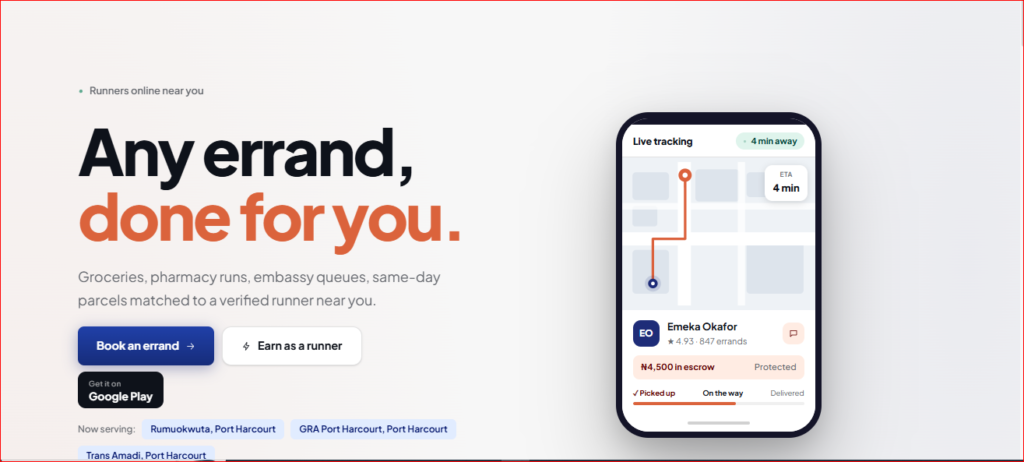
Run Errands is aiming at something broader. According to the platform, users can request help with groceries, pharmacy runs, parcel collection, queueing at institutions such as embassies, NIMC, banks and FRSC offices, office runs involving contracts and documents, food pickups, urgent deliveries and bill payments.
The unifying idea isn’t “delivery.” It’s “get this done.” A customer doesn’t need to know which specific service handles their problem. They describe the task, and the platform is meant to route it to someone who can execute it.
That distinction — task marketplace versus delivery company — is small in wording but large in ambition.
The Real Currency Is Time
Ask most Run Errands customers what they’re actually buying, and the honest answer probably isn’t “an errand.” It’s time back.
A professional who can’t leave work to collect medicine. A business owner who needs an item sourced from a market across town. A Nigerian abroad who needs someone physically present to check on a property or hand something to a relative. None of these require sophisticated logistics infrastructure. They require a trusted person who can be there instead of you.
Run Errands’ bet is that instead of building a large in-house workforce capable of doing everything, it can connect customers to independent runners who choose which jobs to take on. The customer gets convenience without having to personally track down a service provider. The runner gets a way to turn spare time and mobility into cash. And the platform, at least on paper, gets a business that can stretch across categories without hiring a specialist for every one of them.
How It Actually Works
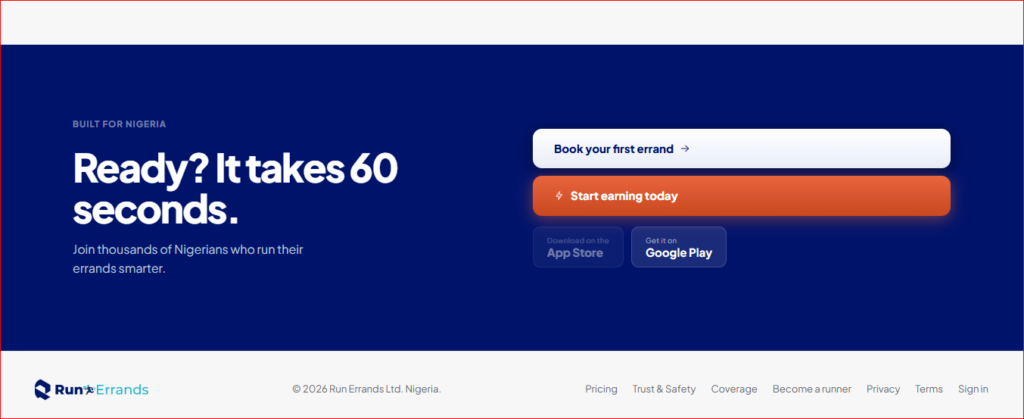
The mechanics are deliberately unfussy. A customer describes the errand, picks a category, provides pickup and drop-off details where relevant, and names a price. Run Errands says this can be done from any device in about 60 seconds.
The request then goes out to verified runners nearby, who the company says can accept an errand in under 90 seconds on average during active periods. Once a runner accepts, the customer can follow the job on a real-time map, communicate through the app, and receive photo proof once the item is dropped off.
The detail that matters most, though, is what happens to the money. Payment isn’t handed to the runner upfront. It sits in escrow until the customer confirms the job is done.
That single design choice does a lot of quiet work.
Trust Is the Actual Product
The hardest part of building an errand marketplace was never matching supply with demand. It’s trust.
Handing a stranger money, a location, a document, or a shopping list is not a small ask. Nigeria’s informal economy has always solved this through relationships instead of systems — a neighbour’s recommendation, a colleague’s regular dispatch rider, a family friend in another city. What Run Errands is really trying to do is take that informal trust mechanism and put it into an app.
The company says every runner passes NIN verification, a live selfie check and address confirmation before their first job, and that customers can see a runner’s rating history and completed errand count before deciding whether to proceed. If you strip the app down to its core, that reputation layer might matter as much as the errand itself. Every completed job is one more small piece of evidence about whether a runner can be relied on.
Payment security reinforces the same idea. Run Errands says customers top up a wallet via card or bank transfer, with funds locked in escrow once an errand is posted and released to the runner after delivery is confirmed, or through the platform’s stated fallback process if the customer doesn’t respond. Payments run through Paystack and Flutterwave. Neither side is operating purely on faith anymore — the platform is holding the risk in the middle.
Visibility adds a third layer. The company says customers can track a runner via live GPS, communicate in-app, and receive photo proof at delivery, alongside safety features including one-tap SOS, masked phone numbers and a PIN requirement at handoff. Instead of a string of phone calls asking “did you get there yet,” the information sits inside the app.
The Runner Side of the Equation
A Run Errands runner isn’t quite a delivery rider in the conventional sense. The job might be collecting a document, standing in a queue, or sourcing an item from a market — tasks that reward local knowledge and reliability more than speed alone.
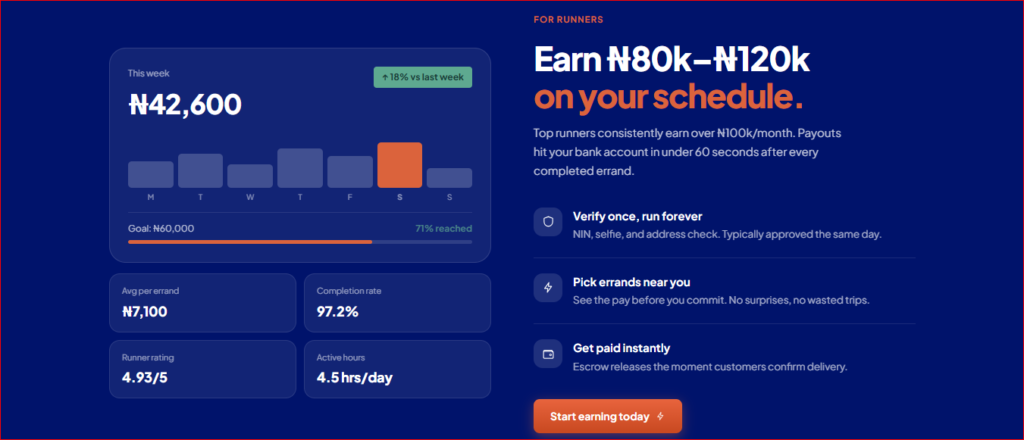
The company says runners can browse errands near them, see expected pay before accepting a task, and get paid after completion, with verification only required once. Run Errands advertises potential earnings in the range of ₦80,000–₦120,000 depending on a runner’s schedule, and says its top runners consistently earn upward of ₦100,000 a month. Those are the company’s own stated figures rather than guarantees — actual earnings will vary with location, demand, and how many errands a runner takes on.
What matters structurally is the progression the model implies: a new runner builds a track record, becomes an active runner, and — if ratings and reliability hold up — becomes one of the preferred runners customers specifically look for. In a reputation-driven marketplace, that climb is the whole incentive system.
Why Small Businesses Might Be the Real Growth Story

A small business doesn’t necessarily need a full-time employee whose entire job is collecting supplies, visiting a supplier, or delivering to customers across town. Those are real costs — salary, time, opportunity cost — for work that happens irregularly. An on-demand runner turns that fixed labour cost into something closer to a variable expense, used only when needed.
Individual convenience is the obvious pitch, but the business case may be where this gets more interesting.
For companies with multiple recurring physical tasks — supplier collections, customer deliveries, document runs — the value isn’t a single errand. It’s a business account that becomes a quiet, embedded part of daily operations. That’s a different kind of customer relationship than a one-off consumer job, and probably a more durable one.
The Diaspora Angle
There’s a use case that doesn’t get discussed enough in Nigerian tech: Nigerians abroad who need something physically handled at home.
Sending money is rarely the hard part anymore. Getting someone to inspect a property, collect a document, or check in on a relative is. The problem isn’t financial — it’s the absence of a trusted person on the ground.
If Run Errands can build a runner network deep enough across Nigerian cities, this could become a real option for the diaspora — less a convenience feature, more a stand-in for the family member who used to handle everything. Nothing in the company’s material suggests this is a proven customer segment yet. It reads more like an opportunity sitting in plain sight.
What Repeat Usage Actually Signals
Downloads and sign-ups are easy vanity metrics for any app. The number that actually matters for a marketplace like this is repetition — whether a customer’s mental model shifts from “I’ll figure this errand out myself” to “I’ll just use Run Errands.”
The same logic applies on the other sides of the marketplace. For a runner, the milestone isn’t completing one job; it’s becoming someone customers request by reputation. For a business, it isn’t placing one order; it’s Run Errands quietly becoming part of how the company operates day to day. A marketplace that only attracts first-time users without converting them into repeat behaviour is a marketplace that hasn’t actually solved the trust problem yet — it’s just found people willing to try once.
The Hard Part Is Always Scaling
None of this is easy to pull off.
A marketplace needs enough customers to make it worthwhile for runners to hang around, and enough runners on the ground to keep response times fast enough that customers don’t just give up and run the errand themselves. Those two sides have to grow roughly in step, city by city — which is a much slower, more deliberate process than simply pushing app downloads.
Quality is also not something that scales automatically. A runner who performs well in one neighbourhood doesn’t guarantee the same experience in a different part of a different city. That means Run Errands’ medium-term success will hinge on unglamorous operational work: verification consistency, dispute resolution, customer support, and payment reliability, sustained across an expanding map. According to the company’s website, it is currently expanding across Nigeria, directing users to check its coverage information to confirm whether a particular location is live.
There are also the usual marketplace risks that come with handling other people’s money and belongings by proxy — fraud attempts, disputes over what was or wasn’t delivered, and the unit economics of keeping escrow, verification and support running at a reasonable cost. None of these are unique to Run Errands, but they’re the kind of friction that determines whether a promising idea becomes durable infrastructure or stays a convenience app people use occasionally.
Could This Travel Beyond Nigeria?
Run Errands has said it wants to become a leading convenience and personal logistics platform across Africa. That’s easy to say in a pitch deck. Whether it’s achievable is a different question entirely.
Some parts of the model are close to universal: the escrow logic, the ratings system, the basic idea of matching a described task to a nearby verified person. Other parts are stubbornly local. Identity verification systems differ by country. Payment rails differ by country. Trust, in particular, doesn’t transfer automatically — a reputation system built on Nigerian runners in Lagos and Abuja doesn’t mean much to a first-time customer in Nairobi or Accra until a local runner base builds its own track record from scratch.
Expansion, in other words, isn’t really a technology problem. It’s a trust-building problem, city by city, all over again.
Convenience Infrastructure, Not Just Convenience
Step back far enough and the pattern looks familiar. Digital banking made it possible to move money without visiting a bank. E-commerce made it possible to buy things without visiting a store. Ride-hailing made it possible to get transportation without standing on the roadside and hoping.
In each case, the underlying physical activity didn’t disappear — moving money, moving goods, moving people still happens. What changed was the layer of discovery, trust and coordination sitting on top of it.
Run Errands is attempting the same move for a category that has resisted digitisation longer than most: the errand. Documents still have to be collected. Queues still have to be stood in. Items still have to be physically bought and carried somewhere. Technology can’t remove that physical requirement. What it can do is make the process of finding, verifying, tracking and paying the person who does it dramatically more efficient.
Nigeria has spent the last decade digitising the transaction. What remains is the task itself — and that may be the more interesting frontier. Whether Run Errands becomes the layer that connects the two, or simply one of several attempts to do so, will depend less on the app than on whether it can make strangers trust each other, one completed errand at a time.

The WIRED.Africa's Press Desk delivers breaking news, official announcements, and timely updates on technology, business, innovation, and digital policy. Stories published under this byline are produced through the collaborative efforts of the editorial team and trusted news sources.