A Virginia startup just relaunched Twitter under its old name and its old bird — with no blessing from Elon Musk. A Delaware court will eventually decide whether that’s legal. Operation Bluebird isn’t waiting around to find out.
For three years, saying “I’m on Twitter” has been technically inaccurate. The platform Elon Musk bought for $44 billion became X in July 2023, and the bird, the word “tweet,” and the blue-and-white branding were supposed to disappear along with it. Last week, a small team of trademark lawyers decided that promise was actually a loophole — and relaunched Twitter without him.
The platform is called Twitter.now. It has a blue bird for a logo, a reply-and-retweet interface that will feel instantly familiar to anyone who used the site before 2023, and a legal theory that could either collapse in a Delaware courtroom or hand a group of outside lawyers one of the internet’s most recognisable brands, essentially for free.
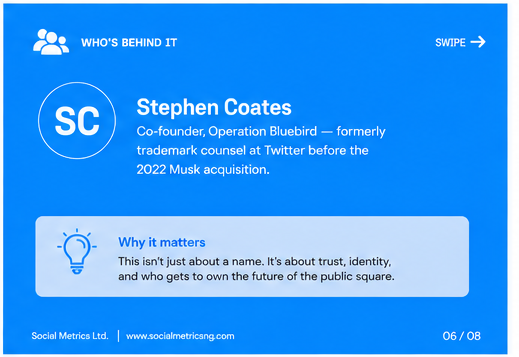
The company behind it, Operation Bluebird, isn’t a meme account chancing its arm. It’s run by two trademark attorneys — Illinois-based Michael Peroff and Stephen Coates, who worked on Twitter’s own trademarks, domain names and marketing between 2014 and 2016 and now serves as Bluebird’s general counsel. According to Dealroom, Peroff spent almost two years building the case before either of them wrote a line of product code.
Their argument is simple to state and expensive to prove: when Musk publicly retired the Twitter name in 2023, he abandoned the trademark rights that came with it, under long-standing US trademark law. Abandon a mark for long enough, with no genuine intent to use it again, and it becomes fair game for whoever files first. Bluebird filed first. X Corp. has been suing to stop exactly this outcome since December 2025 — and, as of this week, has lost that race, at least for now.
The Basics
- What launched: Twitter.now, a social platform from startup Operation Bluebird, opened to paying early members in the final week of August 2026.
- Who’s behind it: Trademark attorneys Michael Peroff and Stephen Coates, the latter formerly of Twitter’s own trademarks and domains team.
- The legal fight: X Corp. v. Operation Bluebird, Inc., Case No. 25-1510-CFC, US District Court for the District of Delaware, before Judge Colm Connolly.
- Where it stands: A judge tentatively signalled in April 2026 that X may have abandoned some Twitter-related trademarks — but has issued no written ruling.
- Cost to join: $20 for a numbered “Founder” membership; $40 and up for a “Fighter” tier that also helps fund the legal defence.
What Actually Launched
Strip away the legal drama and Twitter.now looks a lot like, well, Twitter — deliberately so. Members can post, reply and retweet (Bluebird kept the word, trademark fight and all). Early members get a numbered founder badge and first pick of the username they want; Coates, unsurprisingly, claimed Founder #00001 for himself. Ars Technica, which broke the launch, reported that the service still counts its users in the hundreds, not the millions — this is a scrappy early-access product, not a Twitter-scale rival, at least not yet.
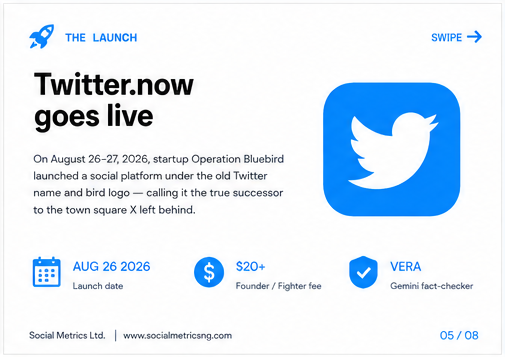
Where it diverges from the platform it’s named after is a feature called Vera — an automated “veracity engine” built on Google’s Gemini models that checks posts for accuracy in real time. Coates has reportedly been stress-testing it by posting deliberately false claims, like naming the wrong US president, to see whether the system catches them. The philosophy behind it, in Coates’s own words, is “freedom of speech and not freedom of reach” — the idea that people can say what they want, but the platform won’t algorithmically reward the loudest or most inflammatory posts with extra distribution.
Who’s Behind The Bird
Coates announced the launch himself, on LinkedIn, with a post that read simply: “Get over your X.” It’s the kind of line that plays well on social media and rather less well in a courtroom, but it captures the tone of a company that is treating this as equal parts legal strategy and cultural troll. In an interview with Ars Technica, Coates put it more plainly: “We are not X and are not affiliated with X Corp.” — a distancing that is as much a legal disclaimer as it is a marketing line, since Bluebird’s entire case rests on Twitter and X being, in trademark terms, two separate things now.
Bluebird’s Case: “You Left, We Didn’t”
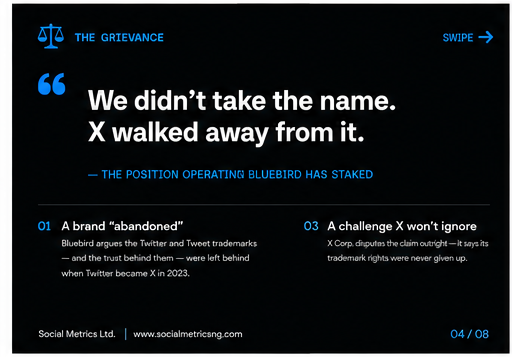
On December 2, 2025, Operation Bluebird filed a 105-page petition with the US Patent and Trademark Office’s Trademark Trial and Appeal Board, seeking to cancel X Corp.’s registrations for TWITTER and TWEET. The petition argued that the marks had been “effectively abandoning the storied bird, with no intention to resume use of the mark” once X Corp. scrubbed the branding from its products, marketing and public statements, according to the filing language reported by AOL/PA Media. Bluebird pointed to Musk’s own 2023 announcement that the company would “bid adieu to the Twitter brand” as evidence of intent to abandon it.
X Corp. did not see it that way. Two weeks later, on December 17, 2025, it sued Bluebird in Delaware federal court, seeking a preliminary injunction to block the new platform before it could launch. X’s complaint, obtained and quoted by The Register, was blunt: “Twitter never left” and remains, in the company’s telling, exclusively owned by X Corp. — which noted that more than four million people a day still access the service through the twitter.com domain.
What Twitter.now Says It’s Building
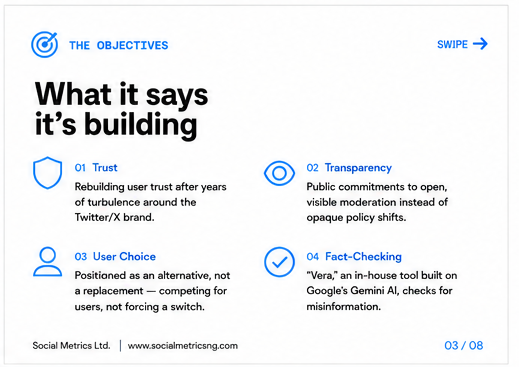
Bluebird is careful to frame Twitter.now as more than a legal stunt wrapped in nostalgia. Its public pitch rests on four ideas: rebuilding user trust after years of turbulence around the Twitter/X brand; more transparent, visible moderation instead of opaque policy changes; positioning itself as an additional choice for users rather than a forced replacement; and Vera, the fact-checking layer described above. Whether any of that survives contact with a real user base — and a well-funded legal opponent — is the open question the rest of this story is really about.
Inside The Courtroom
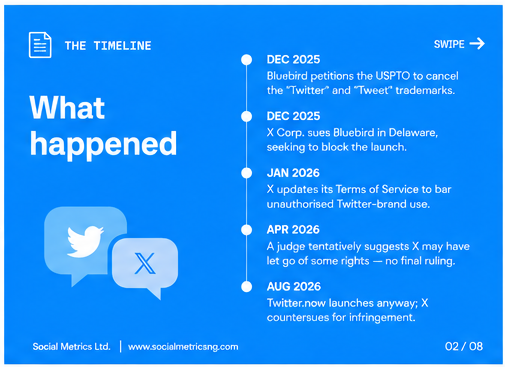
The case, formally X Corp. v. Operation Bluebird, Inc., C.A. No. 25-1510-CFC, has moved in fits and starts. After X’s December 2025 lawsuit, it revised its own Terms of Service, effective January 15, 2026, to explicitly bar unauthorised use of the Twitter name, marks, logos or domains — a defensive move seemingly aimed at shoring up its case. The real turning point came in April 2026, at a hearing where Judge Colm Connolly gave a preliminary, spoken-from-the-bench view that X appeared to have relinquished its rights to the word “tweet” and the bird logo, and said he remained undecided on the word “Twitter” itself pending further argument, according to Ars Technica’s courtroom reporting.
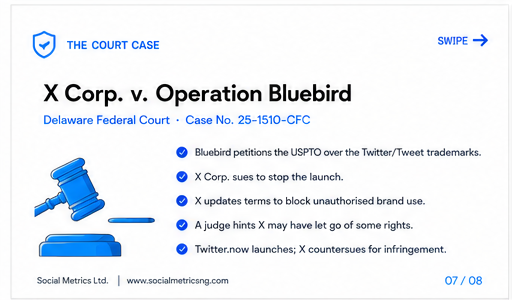
That comment was never turned into a written order. It didn’t need to be, as far as Bluebird was concerned — the company treated the judge’s tentative remarks as a green light and pushed ahead with its launch five months later. Meanwhile, the separate USPTO cancellation proceeding remains formally suspended pending the outcome of the Delaware case, according to Trademark Lawyer Magazine’s case tracking, and more background on the dispute’s origins is available on Wikipedia’s entry for the case. As of this writing, X Corp. has not filed any new lawsuit or amended complaint in direct response to the launch — though legal observers expect that could change.
So, Who Actually Owns The Town Square?
Trademark attorney Josh Gerben, who is not involved in the case, told SFist that Bluebird “may have a viable argument” that X abandoned the Twitter mark — but cautioned that actually launching a live product, rather than waiting for a ruling, sharply raises the stakes and could provoke a fresh legal response from X Corp. That tension is the whole story in miniature: Bluebird is betting that possession, and a working product, are worth more right now than legal certainty. It’s a bet with real precedent behind it — US trademark law does recognise abandonment through non-use — but also real risk, since a single-letter mark like “X” and a three-letter one like “Twitter” rarely change hands this publicly, or this messily.
Why This Matters Beyond Silicon Valley
It would be easy to file this under “American lawyers fighting over a logo” and move on. But the underlying question — who actually owns a platform’s identity once its parent company changes its mind — is one African users and creators have been living with for years, usually with far less leverage than a Delaware court offers. WIRED Africa has covered this tension before: our reporting on X’s own account-monetisation crackdown in Nigeria showed how quickly a platform can change the rules for the creators who built an audience on it, and our analysis of why India paused WhatsApp usernames — and what that means for Nigeria raised the same underlying issue: platforms, not users, ultimately decide who owns a digital identity.
Millions of African users, small businesses and creator-economy accounts built their reach on Twitter long before it became X, and many have stayed out of habit, audience lock-in or simple lack of an alternative worth the switching cost. A credible, non-Musk-controlled version of the platform — if Twitter.now ever becomes that — could theoretically give creators more leverage over monetisation terms and moderation policy than they currently have. Vera’s Gemini-based approach to fact-checking is also part of a wider pattern this year of AI models being embedded directly into moderation pipelines, a trend worth watching regardless of how this particular platform fares.
That’s a big “if,” though. Twitter.now currently has a few hundred users, invite-and-payment friction that Bluesky, Threads and Mastodon don’t impose, and no confirmed roadmap for African payment methods, local moderation teams or Naira, Cedi or Rand pricing. For now, this is a story to watch, not a platform to migrate to.
What We Don’t Know Yet
In the interest of not overselling a genuinely uncertain story: there is still no written court order resolving the trademark dispute, only Judge Connolly’s spoken, preliminary comments from April. X Corp. has not, as of this writing, filed a new suit or amended complaint specifically responding to the August launch, despite widespread expectation that it will. And reception among the small number of people who have actually paid to join has been mixed — Inc.com reported that some early paying members have been underwhelmed by the product itself, separate from the legal fireworks around it.
What Happens Next
Whatever happens next in Delaware, Twitter.now has already done something unusual: it’s forced a real legal test of what happens when a company publicly, deliberately walks away from its own most famous brand. For three years, that question sat untested. Now it sits in front of a federal judge, with a live product and a growing user base as the facts on the ground. This is a developing story, and WIRED Africa will update it as the litigation — and the platform — evolve.
Fact-check note: Every factual claim in this article has been verified against primary court reporting, Operation Bluebird’s own public statements, and multiple independent outlets, including those linked throughout. Case details reflect the public record as of August 31, 2026, and may change as the litigation continues.

Tech Desk at WIRED.Africa reports on cybersecurity, platform security, AI systems, and technical analysis of digital infrastructure shaping Africa and global tech.