





By Wired Africa Staff
Nigeria’s push to transform artificial intelligence policy into measurable public-sector impact will take center stage this week as government officials, technology executives, regulators, and development partners gather in Abuja for AI Summit Nigeria 2026.
Scheduled for June 16 at the Transcorp Hilton in Abuja, the hybrid event is being convened by Nina Jojer Africa, with Microsoft as lead sponsor and support from the National Information Technology Development Agency (NITDA) and MTN Nigeria.
The summit arrives at a critical moment for Africa’s largest economy. Over the past two years, Nigeria has accelerated efforts to establish itself as a regional leader in artificial intelligence governance through initiatives including the National Artificial Intelligence Strategy (NAIS), the N-ATLAS multilingual language model, and broader digital economy reforms.
While policymakers have largely focused on creating frameworks for responsible AI adoption, attention is increasingly shifting toward execution.
“The challenge is no longer whether Nigeria should embrace AI, but how government institutions can deploy it effectively, securely, and at scale,” according to the summit’s organisers.
From AI Policy to Public-Sector Deployment
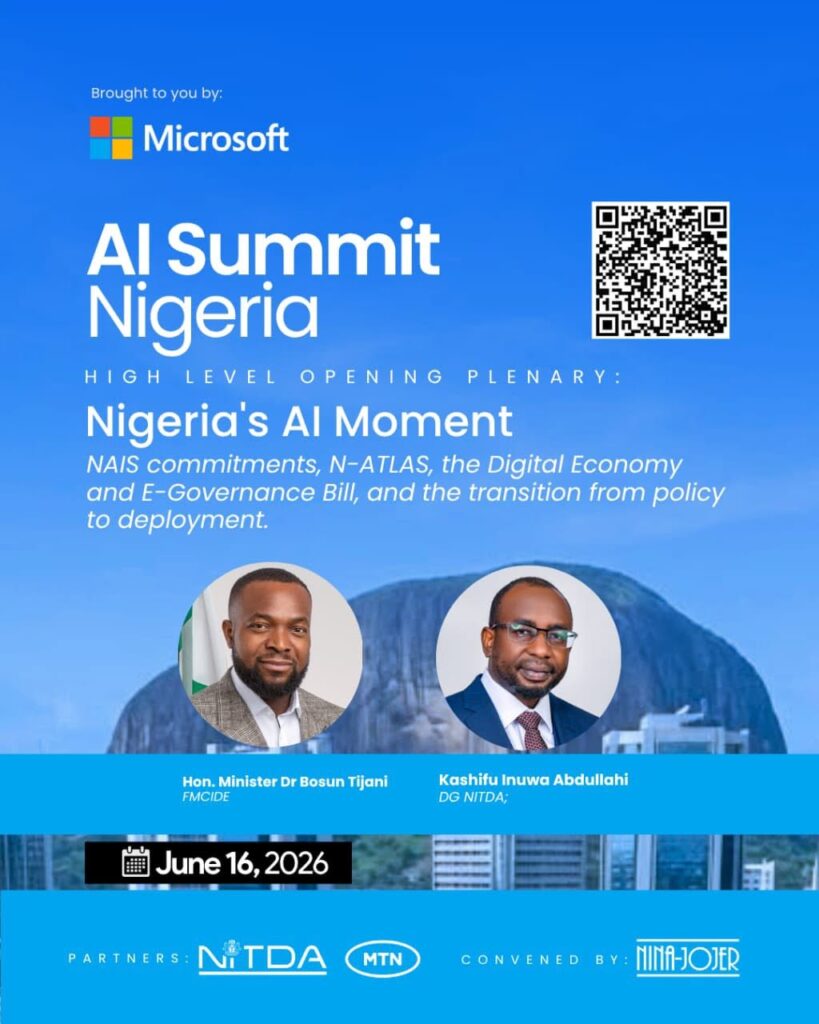
Unlike many technology conferences that focus primarily on emerging innovations, AI Summit Nigeria is positioning itself as a working forum aimed at practical implementation.
Organisers say discussions will focus on the institutional, regulatory, and infrastructure decisions required to integrate artificial intelligence into government operations.
Among the summit’s key themes is the question of regulatory clarity. As ministries, departments, and agencies begin exploring AI-powered services, policymakers are expected to examine how the National Digital Economy and E-Governance Bill 2025 can serve as a framework for responsible deployment.
The event will also address one of Africa’s most debated technology questions: digital sovereignty.
As governments across the continent increasingly rely on cloud infrastructure, global AI models, and international technology providers, policymakers are grappling with how to maintain control over data, computing resources, and digital infrastructure while remaining connected to global innovation ecosystems.
For Nigeria, the conversation has become particularly relevant as demand for AI capabilities continues to grow across both public and private sectors.
AI in Government Services
A major focus of the summit will be identifying practical use cases for artificial intelligence within government institutions.
Discussions are expected to explore how AI can improve service delivery, strengthen citizen engagement, support identity management systems, enhance revenue collection processes, and improve administrative efficiency.
The emphasis on deployment reflects a broader shift occurring across Africa’s AI ecosystem. While many governments have spent recent years developing national AI strategies, fewer have successfully translated policy frameworks into operational systems.
Industry observers say implementation will ultimately determine whether AI becomes a transformative tool for governance or remains largely confined to policy documents and pilot projects.
High-Level Participation
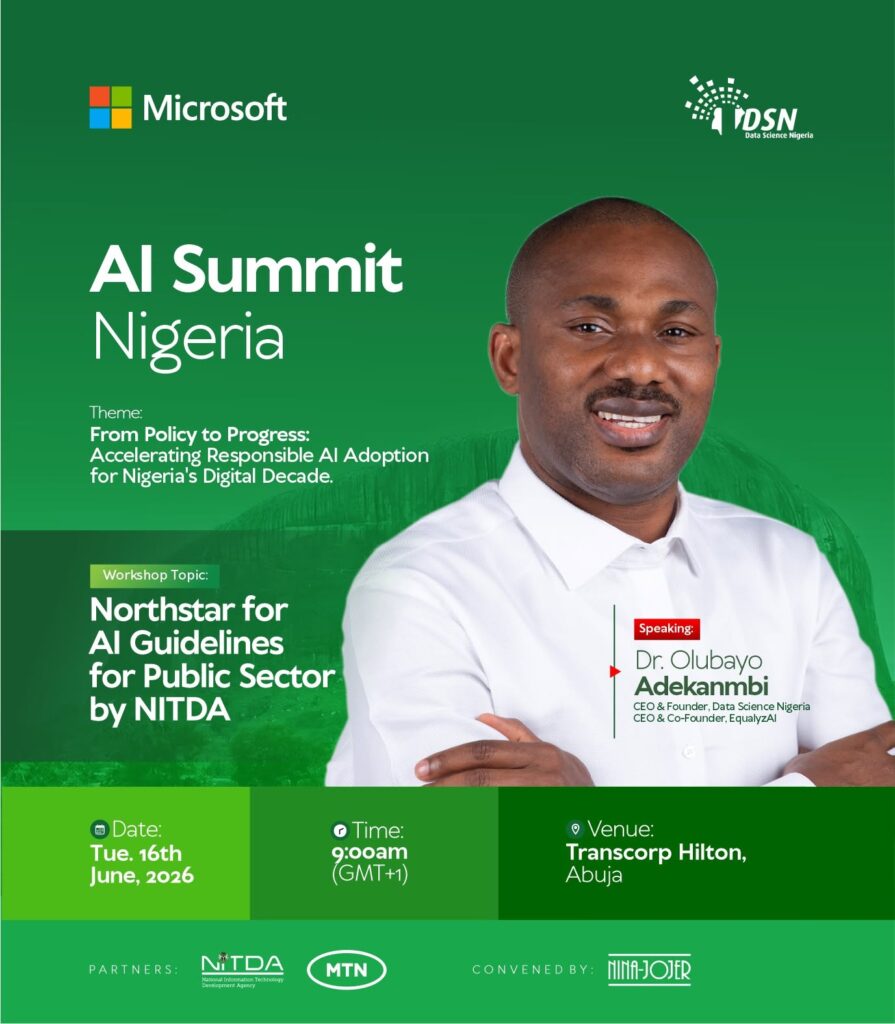
The summit’s speaker lineup reflects the growing convergence of government, technology companies, development institutions, and policy experts around AI governance.
Among the confirmed participants are Minister of Communications, Innovation and Digital Economy Dr. Bosun Tijani; NITDA Director-General Kashifu Inuwa Abdullahi; Microsoft’s Senior Director and Head of Government Affairs for Africa, Akua Gyekye; and representatives from the African Development Bank, Cisco, MTN Nigeria, the Office of the National Security Adviser, UNDP, and Data Science Nigeria.
The diverse mix of participants signals the increasingly multidisciplinary nature of AI adoption, where questions of technology, regulation, cybersecurity, economics, and governance are becoming deeply interconnected.
What Success Could Look Like
Beyond keynote speeches and panel discussions, organisers say the summit is expected to produce tangible outcomes.
These include a policy communiqué intended for submission to the National AI Steering Committee, a proposed government AI deployment framework for ministries and agencies, and a shortlist of public-sector AI pilot projects that could move into implementation with support from technology partners.
Such outputs reflect a growing recognition that AI policy alone is insufficient.
As countries around the world race to integrate artificial intelligence into public services, competitive advantage is increasingly being determined by execution capacity rather than strategy documents.
Nigeria’s AI Moment
The timing of the summit is significant.
Global investment in artificial intelligence continues to accelerate, while governments worldwide are racing to balance innovation with regulation. For emerging economies, the challenge is particularly complex: adopting AI quickly enough to remain competitive while ensuring that deployment aligns with local priorities, infrastructure realities, and governance requirements.
Nigeria has already demonstrated ambitions to play a leading role in Africa’s AI future. Whether those ambitions translate into meaningful public-sector transformation may depend on conversations like those taking place in Abuja this week.
As policymakers, regulators, and technology leaders gather for AI Summit Nigeria 2026, the focus will be less on the promise of artificial intelligence and more on a question that governments around the world are still trying to answer: how to make AI work in practice.

The WIRED.Africa's Press Desk delivers breaking news, official announcements, and timely updates on technology, business, innovation, and digital policy. Stories published under this byline are produced through the collaborative efforts of the editorial team and trusted news sources.



1 comment