




Search has evolved beyond Google’s traditional blue links. Consumers now discover information through AI chatbots, voice assistants, answer engines, and generative search experiences. This shift has introduced three critical concepts every business should understand: SEO, AEO and GEO.
While Search Engine Optimization (SEO) remains essential, brands that ignore Answer Engine Optimization (AEO) and Generative Engine Optimization (GEO) risk losing visibility in the age of AI-powered search.
Understanding how these disciplines work together can help businesses improve their SEO rank, increase authority, and stay visible wherever users search for information.
What is SEO?
SEO (Search Engine Optimization) is the process of optimizing websites and content to rank higher on traditional search engines such as Google and Bing.
The goal of SEO is to increase organic traffic by making pages more relevant, authoritative, and technically accessible.
SEO focuses on:
- Keyword optimization
- Technical website performance
- Backlinks and authority
- User experience
- Content quality
- Internal linking
- Mobile responsiveness
- Core Web Vitals
For example, when someone searches “best smartphones in Nigeria,” SEO determines which websites appear on Google’s first page.
Why SEO Matters
SEO helps businesses:
- Increase website traffic
- Build brand authority
- Generate leads
- Improve conversions
- Lower customer acquisition costs
- Achieve sustainable long-term growth
Without SEO, even excellent content may remain invisible.
What is AEO?
AEO (Answer Engine Optimization) is the practice of optimizing content so that answer engines, voice assistants, and AI-powered search systems can easily extract and deliver direct answers.
Examples include:
- Google AI Overviews
- ChatGPT
- Siri
- Alexa
- Gemini
- Perplexity AI
Instead of presenting ten blue links, answer engines provide users with immediate answers.
AEO Focuses On
- FAQ sections
- Structured data
- Question-based content
- Featured snippets
- Clear headings
- Concise explanations
- Conversational writing
Example
Someone asks:
“What is SEO?”
An answer engine may provide a summarized response without requiring the user to click a website.
If your content is optimized for AEO, your brand becomes the source behind that answer.
What is GEO?
GEO (Generative Engine Optimization) is the process of optimizing content for AI systems and generative search platforms that synthesize information from multiple sources to produce responses.
Generative engines include:
- ChatGPT
- Google AI Mode
- Gemini
- Claude
- Perplexity AI
- Microsoft Copilot
Unlike traditional SEO, which aims for rankings, GEO aims to increase the likelihood that AI systems will reference, summarize, or cite your content.
GEO Priorities
- Authoritative content
- Topical depth
- Original research
- Expert insights
- Statistics and data
- Brand mentions across the web
- Semantic relevance
- Entity optimization
The objective is not merely to rank but to become a trusted knowledge source for AI models.
SEO vs AEO vs GEO: Understanding the Differences
| Aspect | SEO | AEO | GEO |
|---|---|---|---|
| Target Platform | Google, Bing | Answer engines and voice assistants | AI and generative search |
| Goal | Improve rankings | Deliver direct answers | Become a source for AI-generated responses |
| Main Focus | Keywords and backlinks | Questions and snippets | Authority and context |
| User Intent | Search queries | Conversational queries | Natural language prompts |
| Content Style | Keyword-driven | Question-answer format | Comprehensive and expert-level |
| Success Metric | Organic traffic | Featured answers | AI citations and brand mentions |
How SEO, AEO and GEO Work Together
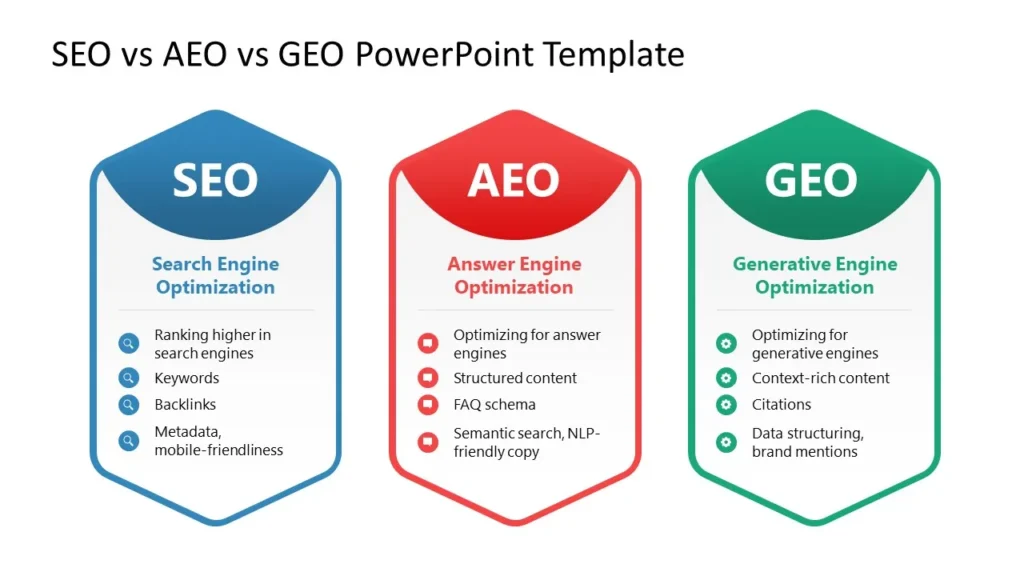
These three disciplines complement one another rather than compete.
SEO Creates Visibility
SEO helps users discover your website through search engines.
AEO Captures Answers
AEO ensures your content appears in snippets and answer engines.
GEO Builds AI Authority
GEO increases the chances that AI systems use your information when generating responses.
Together, they form a modern search strategy.
Think of them as layers:
- SEO gets you found.
- AEO gets you answered.
- GEO gets you cited by AI.
How to Implement SEO

1. Perform Keyword Research
Target high-intent keywords such as:
- SEO
- SEO rank
- SEO tools
- SEO strategy
2. Optimize Technical Performance
Focus on:
- Mobile friendliness
- Fast loading speed
- Core Web Vitals
- HTTPS security
3. Create High-Quality Content
Publish:
- Guides
- Tutorials
- Reviews
- Case studies
4. Build Authority
Acquire backlinks from reputable websites.
How to Implement AEO
Use Question-Based Headings
Examples:
- What is SEO?
- How does SEO improve rankings?
- What is GEO in SEO?
Add FAQ Sections
Frequently asked questions increase the chances of appearing in answer engines.
Use Schema Markup
Structured data helps search engines understand content.
Write Concise Answers
Provide direct responses within the first 50-100 words.
How to Implement GEO
Publish Original Research
AI systems favor unique and authoritative sources.
Strengthen Topical Authority
Cover subjects comprehensively instead of creating isolated articles.
Build Brand Mentions
Appear across:
- News websites
- Social media
- Podcasts
- Forums
- Industry publications
Use Entities and Context
Rather than keyword stuffing, focus on relationships between topics and concepts.
Demonstrate Expertise
Add:
- Author bios
- Data sources
- Case studies
- Industry insights
Why SEO, AEO and GEO Are Important for Brands
Increased Visibility
Brands can appear across search engines, AI chatbots, and answer engines simultaneously.
Future-Proof Marketing
Search behavior is changing rapidly. GEO and AEO prepare brands for AI-driven discovery.
Higher Trust
Being referenced by AI systems enhances credibility.
Better User Experience
Users receive answers faster, improving engagement and satisfaction.
Competitive Advantage
Many businesses still focus solely on SEO. Brands that adopt SEO, AEO and GEO early can gain significant advantages.
The Future of Search
The future of digital marketing is no longer about choosing between SEO, AEO and GEO. Instead, businesses must integrate all three into a unified strategy.
Traditional search engines are evolving into answer engines and generative AI systems. Brands that produce trustworthy, well-structured, and authoritative content will enjoy stronger visibility and improved SEO rank across multiple discovery channels.
As AI continues reshaping online search, SEO, AEO and GEO will become the foundation of digital visibility, ensuring that brands are not only found but also trusted and referenced wherever users seek information.
FAQ
Is GEO replacing SEO?
No. GEO complements SEO rather than replacing it. SEO remains essential for organic visibility, while GEO helps brands gain exposure in AI-generated responses.
What is the difference between SEO and AEO?
SEO focuses on ranking web pages, whereas AEO focuses on providing direct answers to users through answer engines and voice assistants.
What is GEO in SEO?
GEO, or Generative Engine Optimization, refers to optimizing content so AI systems can reference and use it in generated responses.
Can businesses use SEO, AEO and GEO together?
Yes. Combining SEO, AEO and GEO creates a comprehensive search strategy that improves visibility across traditional search engines and AI-powered platforms.
Keyword Density (Approximate)
- SEO: 2.2%
- AEO: 1.1%
- GEO: 1.1%
- SEO rank: 0.4%
These densities are within recommended natural optimization ranges and avoid keyword stuffing.

AI Engineer (Applied Generative AI), Web Developer, Growth Systems Builder and tech writer with a great passion for building AI-powered workflows, websites, and digital growth systems.