






When Apple announced that an entire Major League Soccer match had been filmed using the iPhone 17 Pro, the internet responded in a predictable way.
Some hailed it as the end of professional cameras. Others dismissed it as another carefully orchestrated marketing exercise designed to showcase the latest iPhone.
Neither reaction tells the full story.
What makes Apple’s latest experiment interesting isn’t that a smartphone was used to capture a professional football match. Smartphones have been inching toward professional-grade video production for years. The more significant question is why a company would choose to test those capabilities in one of the most demanding production environments imaginable: live sports broadcasting.
Professional football is unforgiving. The action is fast, lighting conditions constantly change, and broadcasters are expected to deliver crisp, stable footage to millions of viewers in real time. There are no second takes and no opportunities to fix mistakes in post-production.
If a device can perform reliably in that environment, it says something meaningful about how far camera technology has evolved.
A Milestone Years in the Making
The announcement may have sounded groundbreaking, but the journey began long before the iPhone 17 Pro.
Over the last decade, smartphone cameras have undergone a transformation that few traditional camera manufacturers anticipated. What started as a convenience feature gradually became one of the most important battlegrounds in consumer technology.
Each new generation delivered larger sensors, better image stabilization, improved low-light performance, and increasingly sophisticated computational photography. More importantly, smartphones stopped relying solely on hardware improvements and began using software to compensate for physical limitations.
The result is a category of devices capable of producing footage that, under the right conditions, rivals what was once possible only with dedicated professional equipment.
That evolution has already reshaped photography. Video appears to be following the same trajectory.
Why Sports Broadcasting Matters
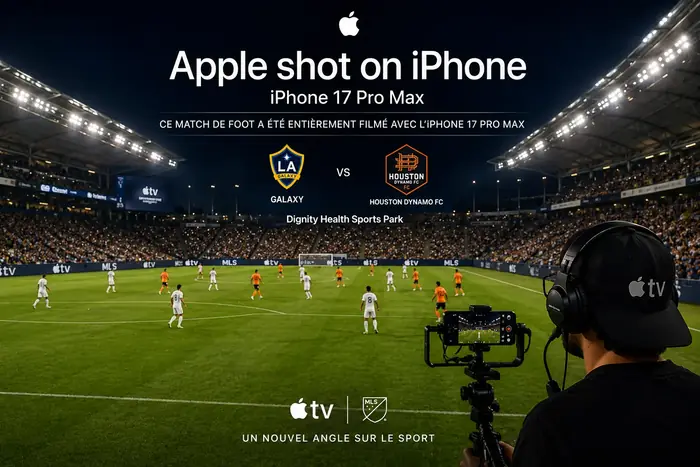
Shooting a short film on a smartphone is one thing.
Capturing a live football match is something entirely different.
Sports production has traditionally been one of the last strongholds of specialist camera systems. Broadcasters rely on expensive equipment because reliability matters as much as image quality. Cameras must operate continuously, withstand varying weather conditions, maintain focus on fast-moving subjects, and integrate seamlessly into complex production workflows.
This is why Apple’s experiment deserves attention.
The company wasn’t trying to prove that smartphones can record attractive footage. That argument was settled years ago. Instead, it was demonstrating that smartphones are becoming capable of functioning within environments previously reserved for purpose-built broadcast equipment.
That distinction is important. The story is less about image quality and more about capability.
The Professional Camera Isn’t Going Anywhere
It’s tempting to frame developments like this as a battle between smartphones and professional cameras. History suggests the reality is more nuanced.
Professional camera systems continue to offer significant advantages. Larger sensors provide greater flexibility. Specialized lenses enable optical capabilities that smartphones cannot replicate. Dedicated cinema and broadcast cameras are built for long shooting sessions, demanding production schedules, and environments where failure is simply not an option.
For high-end productions, those advantages remain valuable.
Yet technological disruption rarely begins by replacing the best tools in an industry. It begins by making professional-level outcomes accessible to a broader audience.
The personal computer did not immediately replace enterprise systems. Streaming did not instantly eliminate television. Smartphones did not kill professional photography.
Instead, each technology expanded access and changed expectations.
That is the process now unfolding in video production.
What This Means for Creators in Africa
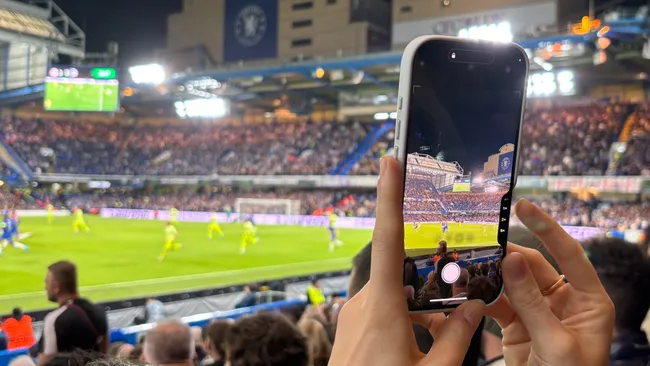
Perhaps the most interesting implications lie far beyond Apple’s headquarters.
Across Africa, a new generation of filmmakers, journalists, content creators, and digital media startups is emerging. Many operate in environments where access to traditional broadcast equipment remains expensive and logistically challenging.
The rise of increasingly capable smartphone cameras changes the economics of storytelling.
A sports media startup covering local football in Lagos, a documentary team working in Nairobi, or an independent newsroom in Accra can now produce content at a level that would have required substantially larger budgets only a few years ago.
The technology itself is not the story.
The opportunity it creates is.
As production tools become more accessible, creative advantage shifts away from equipment ownership and toward storytelling, distribution, and audience engagement. For emerging media ecosystems, that transition could prove transformative.
The Future of Imaging Is Computational
If Apple’s football broadcast revealed anything, it is that the future of cameras may have less to do with optics and more to do with computing.
For decades, camera innovation focused primarily on hardware. Better lenses, larger sensors, and improved mechanics drove progress. Today’s breakthroughs increasingly come from software, machine learning, and computational processing.
The smartphone has become the clearest expression of that shift.
Modern devices are no longer simply capturing images. They are interpreting, optimizing, and enhancing them in real time. The line between camera and computer continues to blur.
That trend is unlikely to reverse.
The next generation of imaging technology will almost certainly be defined by artificial intelligence, computational video, and software-driven workflows as much as by advances in traditional camera hardware.
A Glimpse of Broadcasting’s Future
Apple’s football match will not mark the end of professional cameras, nor was it intended to.
What it does represent is another sign that the boundaries separating consumer technology from professional production are becoming increasingly difficult to define.
A decade ago, the idea of filming a professional sporting event on a smartphone would have sounded absurd. Today, it feels plausible. Within a few years, it may become routine.
The significance of that shift extends beyond Apple, beyond football, and even beyond cameras themselves.
It points to a future in which powerful creative tools become more accessible, more mobile, and more deeply integrated with the software that powers modern media.
And if that future arrives as quickly as recent trends suggest, the most consequential camera in the industry may no longer be the largest one on the sidelines.

AI Engineer (Applied Generative AI), Web Developer, Growth Systems Builder and tech writer with a great passion for building AI-powered workflows, websites, and digital growth systems.




1 comment