


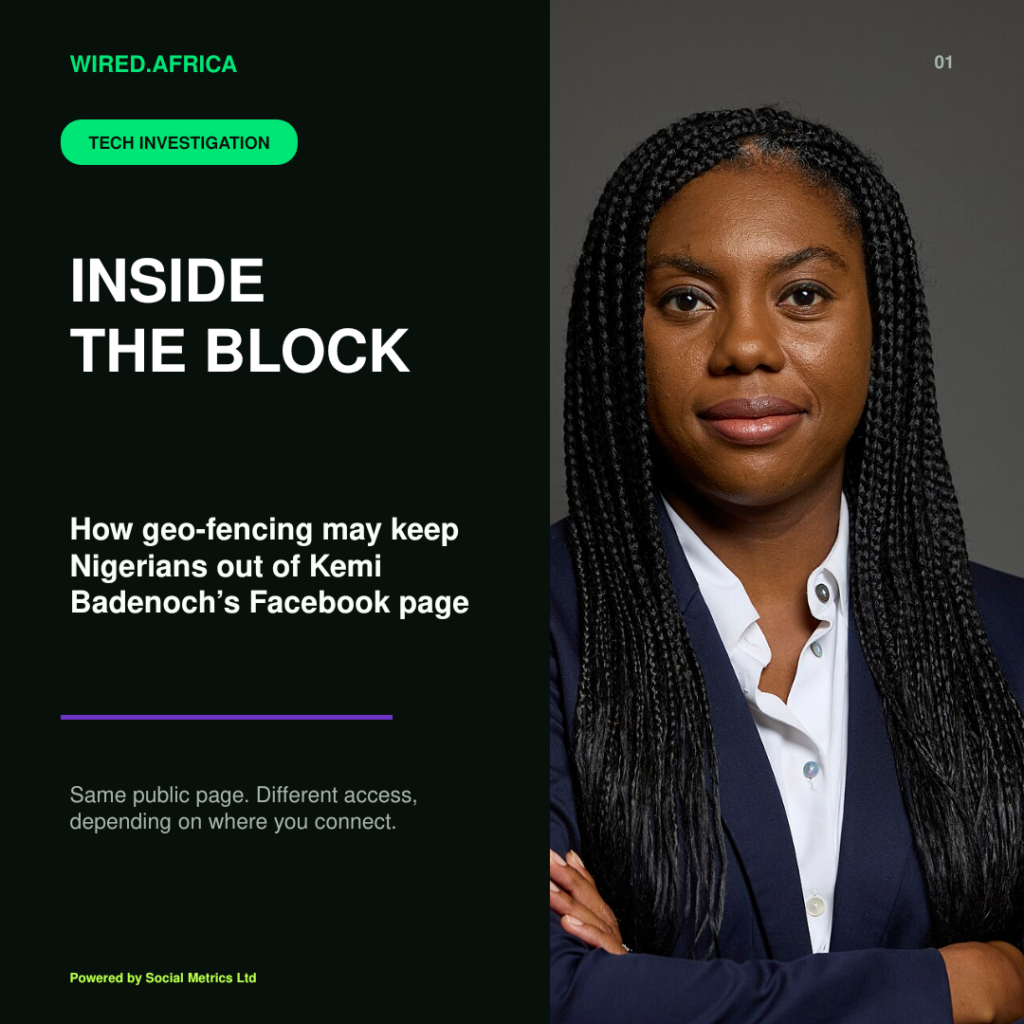
A Wired.Africa investigation finds that the British politician’s Facebook page appears to use location-based restrictions that prevent users connecting from Nigeria from accessing its content.
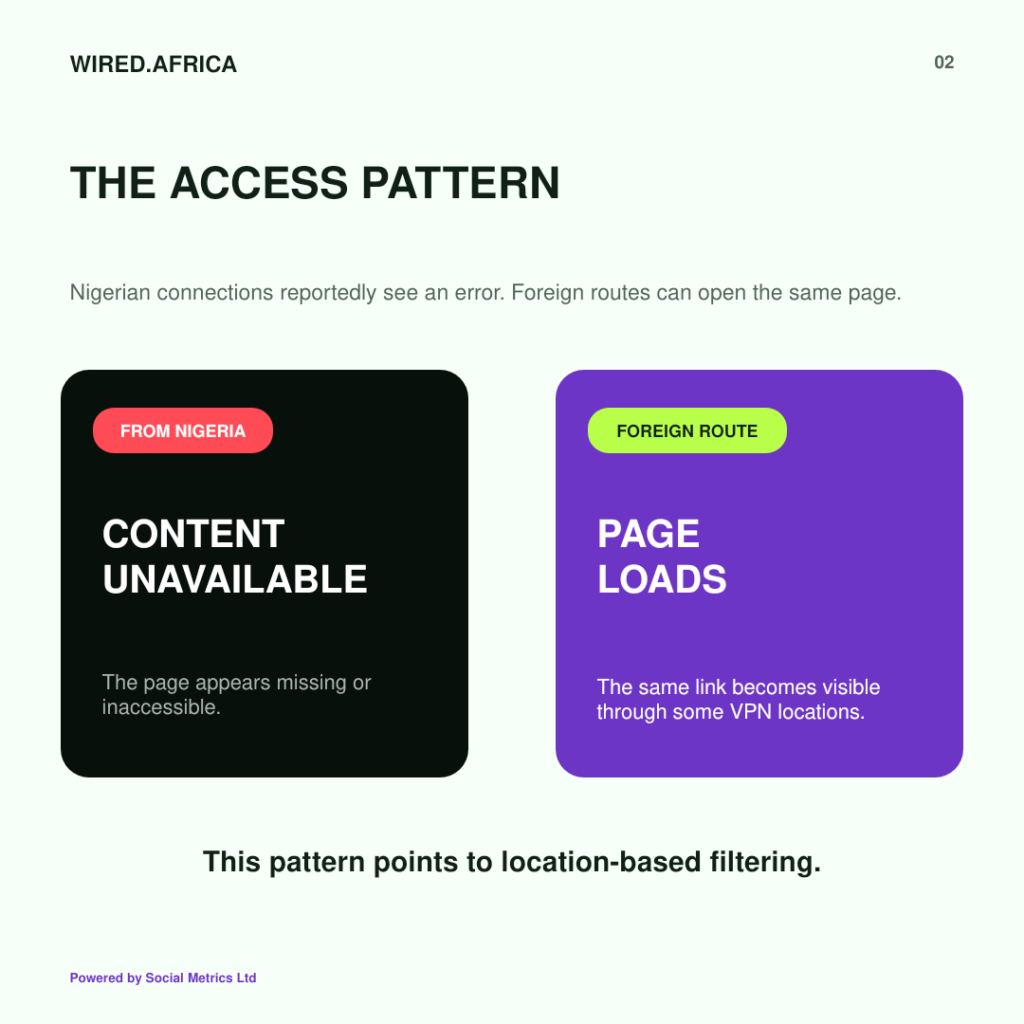
For Facebook users in Nigeria attempting to visit Kemi Badenoch’s official page, the response is often the same: “This content isn’t available right now.”
The page has not disappeared. It remains accessible from the United Kingdom and several other locations. But when the same link is opened through a Nigerian internet connection, access is denied.
Tests conducted by Wired.Africa indicate that the difference is geographic. When Nigerian users activate a virtual private network and route their connections through a server outside Nigeria, the page becomes accessible again.
This pattern strongly suggests that Nigerians are encountering a digital barrier commonly known as geo-fencing.
Although only Meta and the page’s administrators can confirm the exact configuration on Kemi Badenoch Facebook, the test results are consistent with a country-level audience restriction.
How Facebook geo-fencing works
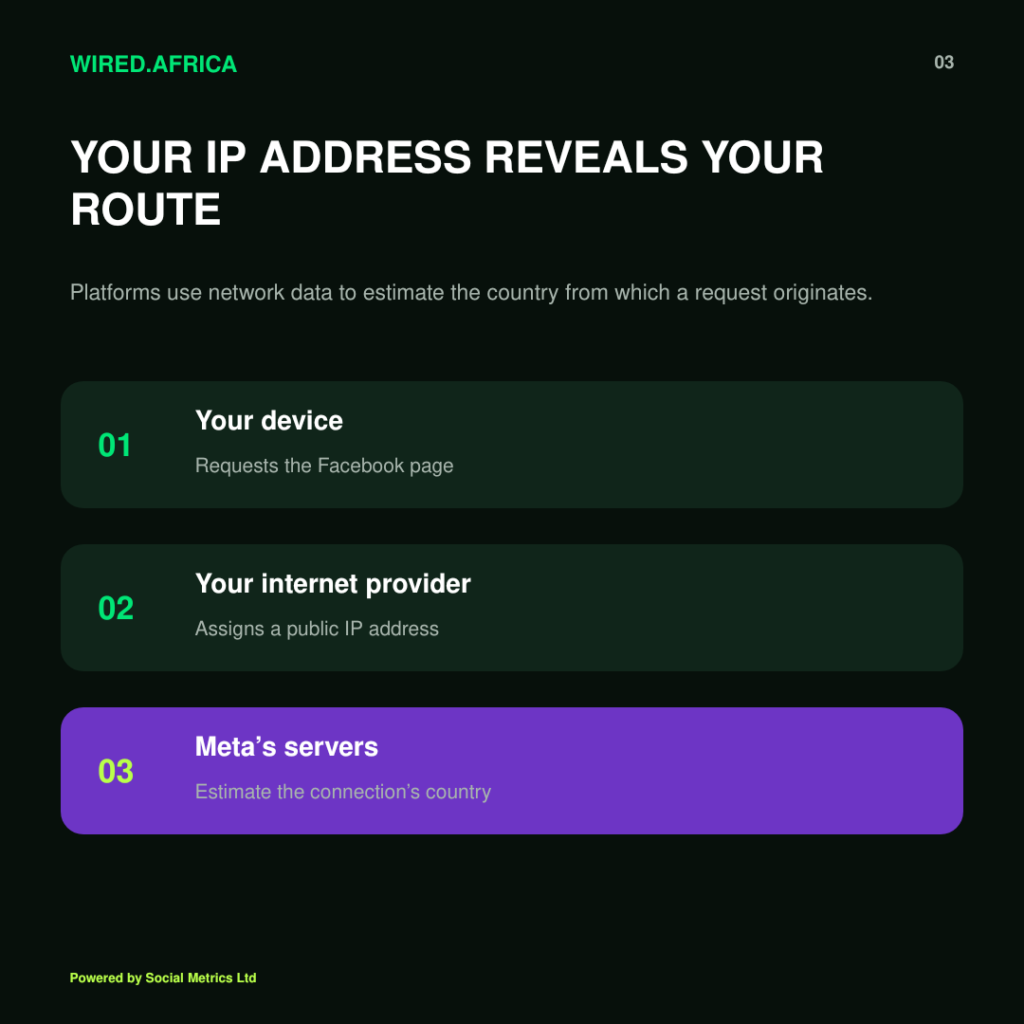
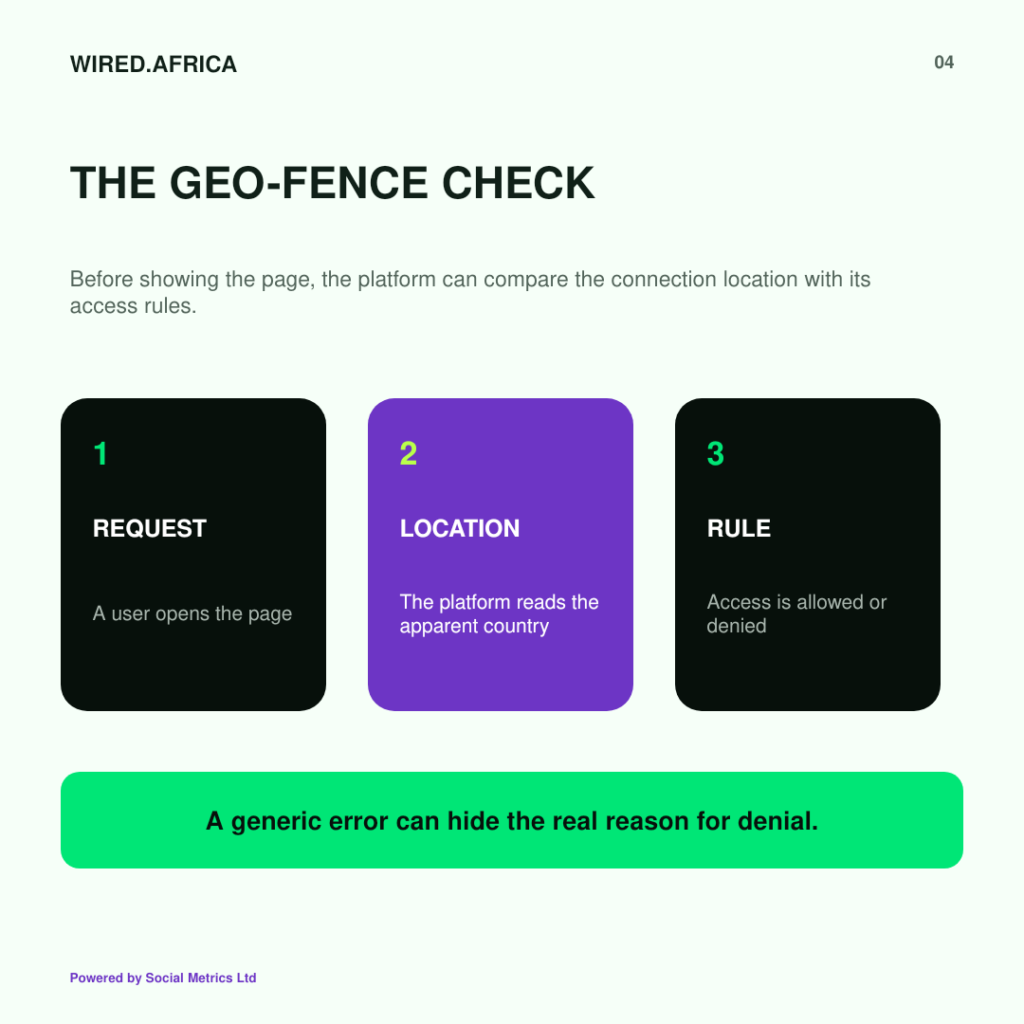
Geo-fencing allows a platform or content owner to control access based on a user’s approximate geographic location.
Every internet connection has an Internet Protocol address. While an IP address does not normally reveal someone’s precise physical address, it can help online platforms identify the country, region and internet service provider associated with the connection.
When a user attempts to open a Facebook page, Meta’s servers examine the request before returning the content. If the request originates from a location covered by an access restriction, Facebook may display a generic “content isn’t available” message.
That message can create the impression that the page has been deleted, suspended or made private. In reality, it may remain fully visible elsewhere.
Kemi Badenoch Facebook: The VPN test
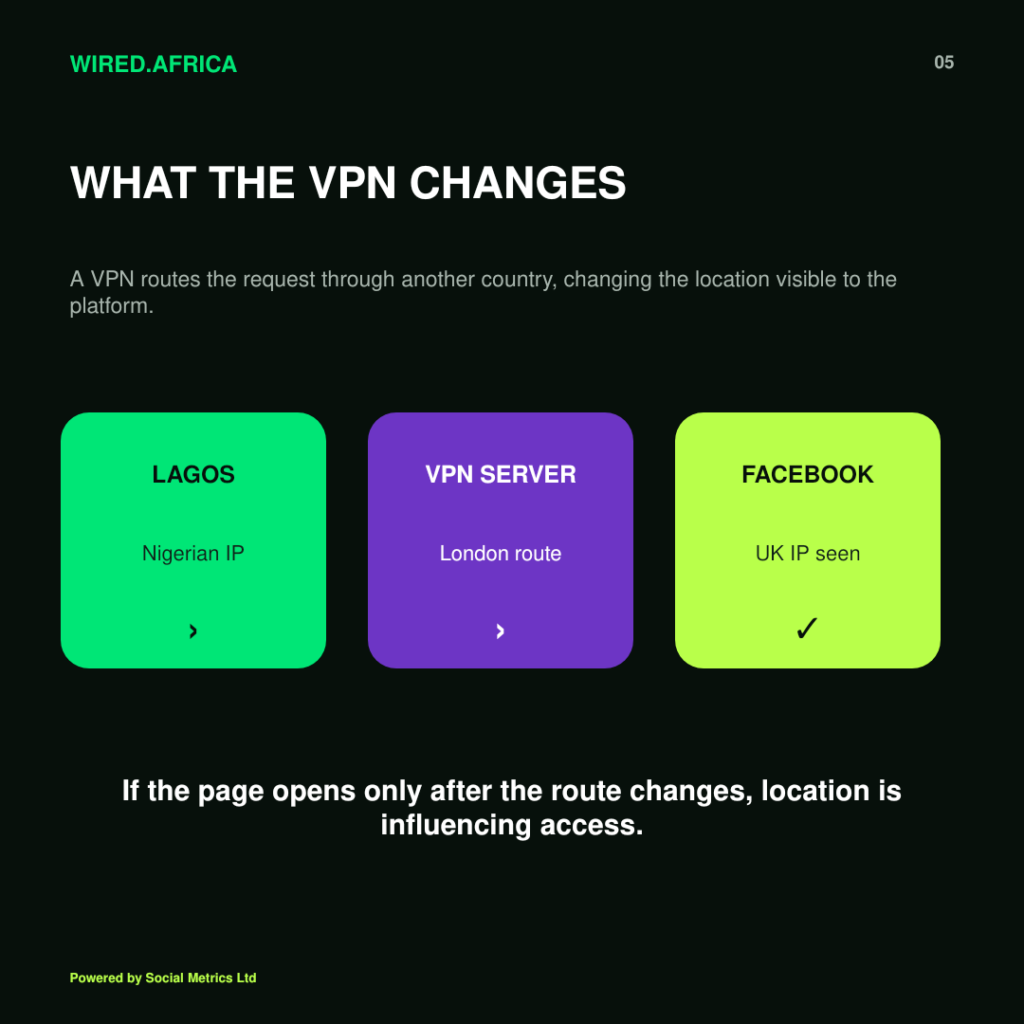
A VPN routes a user’s internet traffic through a remote server in another location.
For example, a user in Lagos who selects a VPN server in London will still be physically present in Nigeria, but websites may read the connection as originating from the United Kingdom.
The process is straightforward:
- A Nigerian user connects to a foreign VPN server.
- The VPN substitutes the Nigerian IP address with its own foreign address.
- Facebook receives the request from the VPN server.
- If that country is not restricted, the page becomes visible.
This is what makes VPN testing useful when investigating suspected geographic restrictions. If a page repeatedly fails to load through Nigerian networks but becomes available through foreign connections, location is almost certainly influencing access.
However, the test cannot independently reveal whether the restriction was imposed by the page’s administrators, Meta or another technical policy affecting the account.
Why Nigeria?
Badenoch was born in London but spent part of her childhood in Lagos. Her public comments about Nigeria and her relationship with the country have repeatedly attracted criticism from Nigerians online.
In 2025, she said she no longer considered herself Nigerian, explaining that she had not renewed her Nigerian passport in decades. The remarks generated widespread debate and criticism across Nigerian social media.
That history provides important context for the apparent restriction.
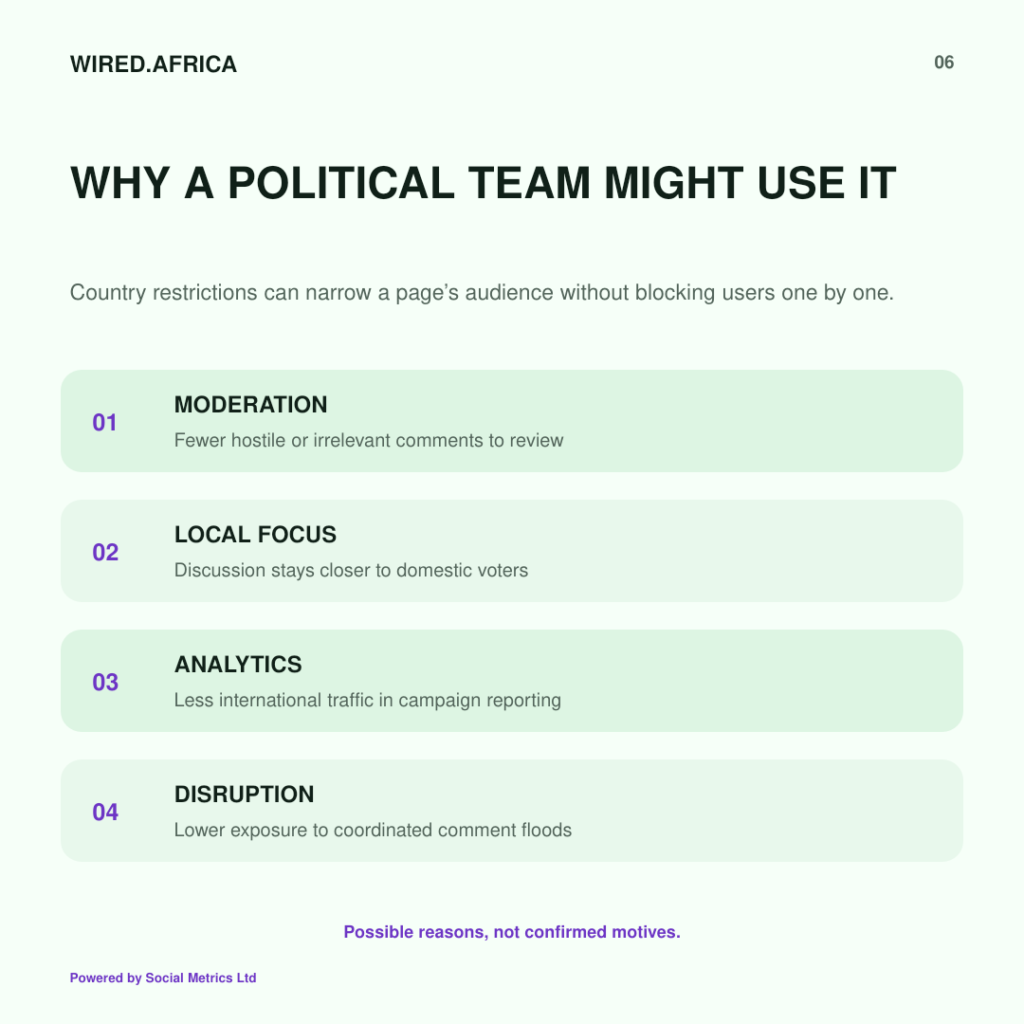
Political pages facing intense criticism from a particular country may use geographic controls to reduce hostile comments, mass reactions, spam and coordinated reporting. Restricting a country can also help a campaign keep its online conversations focused on domestic voters.
If the Nigerian restriction was deliberately imposed by Badenoch’s team, it may have been intended to:
- Reduce the volume of critical comments from Nigerian accounts.
- Limit the moderation burden on the page’s administrators.
- Keep discussions focused on British voters and domestic politics.
- Protect campaign analytics from large volumes of international traffic.
- Reduce the risk of coordinated reporting or disruptive engagement.
These are reasonable technical and political explanations, but they should not be presented as confirmed motives without a response from Badenoch’s office.
A quiet form of digital exclusion
Facebook Geo-fencing is less visible than a government ban. There is no public announcement, nationwide service disruption or obvious network failure.
Facebook continues to operate normally. Other pages remain accessible. Only the restricted page appears to be missing.
That makes page-level geo-fencing particularly difficult for ordinary users to detect. Two people can click the same public link at the same time and see entirely different versions of the internet simply because they are connecting from different countries.
For political figures, this provides a powerful method of controlling online audiences. Rather than removing individual critics, administrators can potentially exclude an entire country from viewing or interacting with their content.
The measure may make moderation easier, but it also raises questions about transparency. Journalists, researchers and ordinary readers can be locked out alongside abusive accounts without being told why.
Not the same as a government ban
A page-level geographic restriction differs significantly from a nationwide social-media ban.
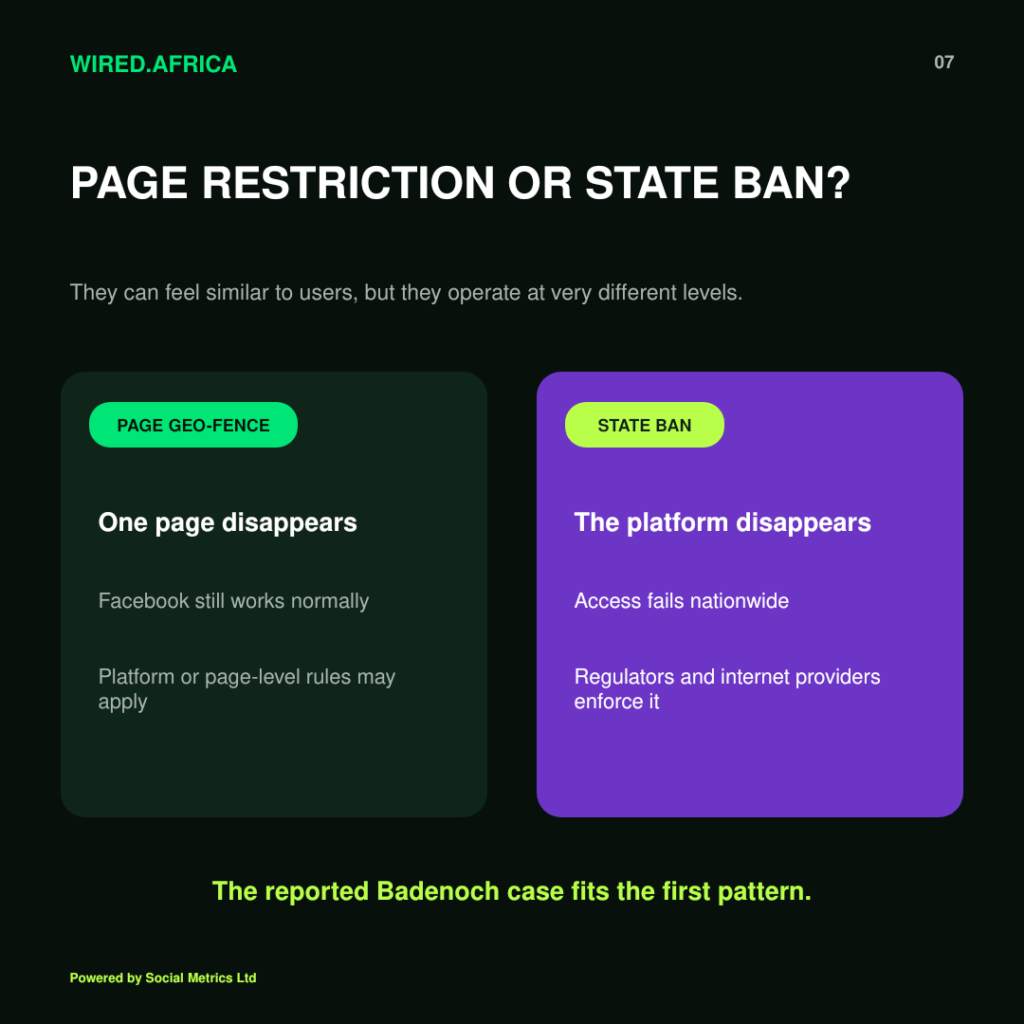
| Page-level geo-fencing | Government platform ban |
|---|---|
| Affects a particular page or account | Affects an entire platform |
| Usually applied through platform controls | Enforced by regulators and internet providers |
| Other Facebook pages remain accessible | Facebook may become inaccessible nationwide |
| Often displays a content-unavailable message | Usually causes timeouts or network errors |
| A foreign VPN may reveal the restricted page | A VPN may restore access to the entire platform |
Nigeria’s 2021 suspension of Twitter, now called X, was a state-level restriction affecting access to the platform across the country. The apparent restriction involving Badenoch’s page is narrower: Facebook works normally, but one particular political page becomes unavailable when accessed through Nigerian connections.
The internet is not equally visible to everyone
The case challenges the popular idea of social media as a single, borderless public square.
What users see is increasingly shaped by location, platform policies, account settings and automated access rules. A public page may be visible in London, hidden in Lagos and available again the moment a Nigerian user changes the apparent location of their connection.
Wired.Africa’s tests indicate that Kemi Badenoch’s Facebook page is being served differently to users based on their geographic location. The precise source and purpose of that restriction still require confirmation from Meta and Badenoch’s office.
What the evidence already demonstrates, however, is that the digital border exists—and Nigerian users appear to be standing on the restricted side of it.

Tech Desk at WIRED.Africa reports on cybersecurity, platform security, AI systems, and technical analysis of digital infrastructure shaping Africa and global tech.

AI Engineer (Applied Generative AI), Web Developer, Growth Systems Builder and tech writer with a great passion for building AI-powered workflows, websites, and digital growth systems.