


Can a Space Mirror Satellite Light Up the Night? A US Test Is Coming…
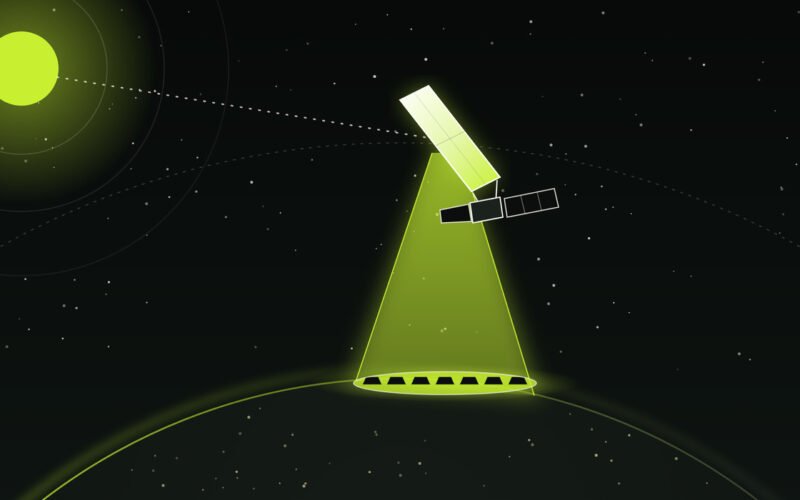
Picture a patch of ground about three miles wide, glowing at night because a mirror in orbit is bouncing sunlight down onto it. That is the test a California startup plans to run later this year with a space mirror satellite called Earendil-1.
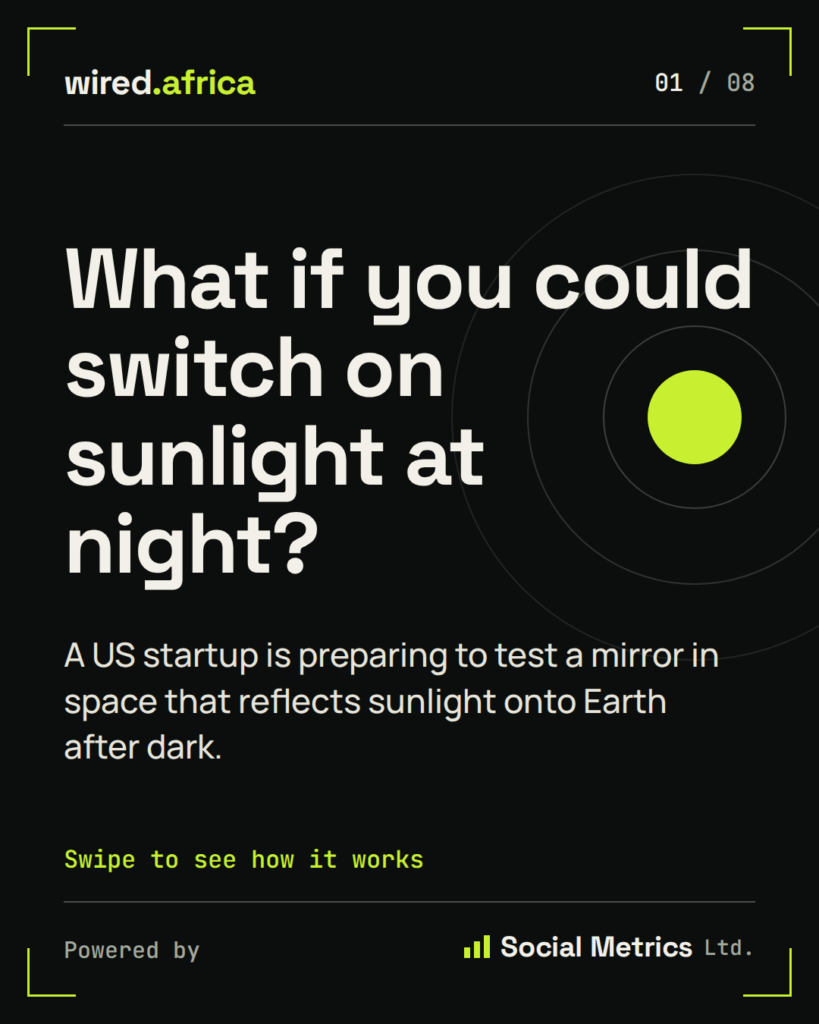
The company, Reflect Orbital, has cleared a US regulatory step toward launching its first test satellite. It says the idea could give solar farms extra hours of light. Astronomers, wildlife groups and lighting experts say the risks are not yet understood, and some have asked regulators to reverse the approval. This article sets out what is confirmed, what is still only a claim, and what to watch next.
Key facts at a glance
- Company: Reflect Orbital, based in California.
- Test satellite: Earendil-1, a single demonstration mission.
- Mirror: a thin-film reflector about 59 × 59 feet (18 × 18 metres), motorised and steerable (Journal of Space Commerce).
- Orbit: about 625 km (388 miles) up, near-polar.
- Light spot: about 3 miles (5 km) wide (Phys.org).
- Launch: planned for later in 2026; the company has not named a date (Aerospace America).
- US decision: July 9, 2026, a radio licence covering one satellite.
- Challenge: filed August 6, 2026, asking the full Federal Communications Commission (FCC) to reverse the approval.
What is a space mirror satellite?
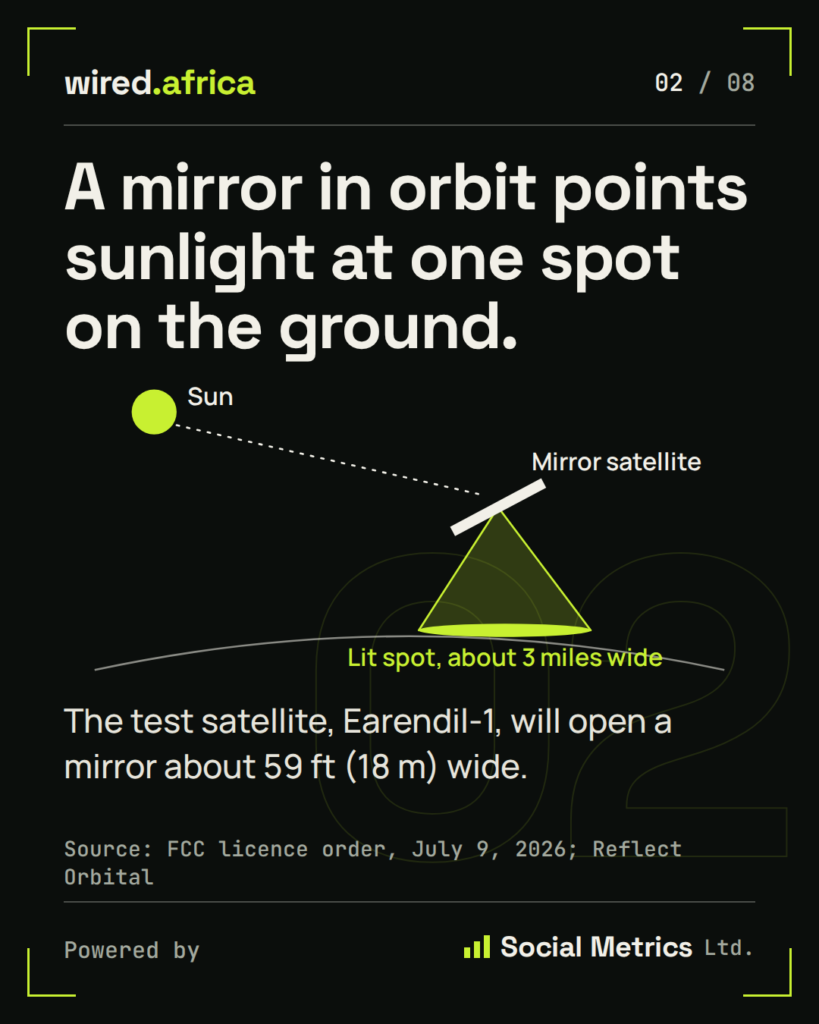
A space mirror satellite is a spacecraft that carries a large reflective surface to redirect sunlight to a chosen place on Earth. Earendil-1 will unfold its reflector after reaching low Earth orbit. According to the FCC licence, the reflector is designed to send light only to a designated target on the ground at night (KTLA).
Because the satellite moves quickly, it can light any one spot only briefly. One analysis says the reflector must be repointed about every four minutes (The Conversation). Reflect Orbital says the light can be adjusted or switched off by rotating the satellite (NBC News).
How bright would the light be?
Reflect Orbital says Earendil-1 is meant to show brightness similar to a full moon over an area about 3 miles wide (Phys.org). Other reports put it higher. Scientific American describes a beam up to four times brighter than a full moon for anyone inside it, and DarkSky International cites 0.8 to 2.3 lux for the illumination levels the company has described. These figures differ, so independent measurements after launch will matter.
What the FCC approved, and what it did not
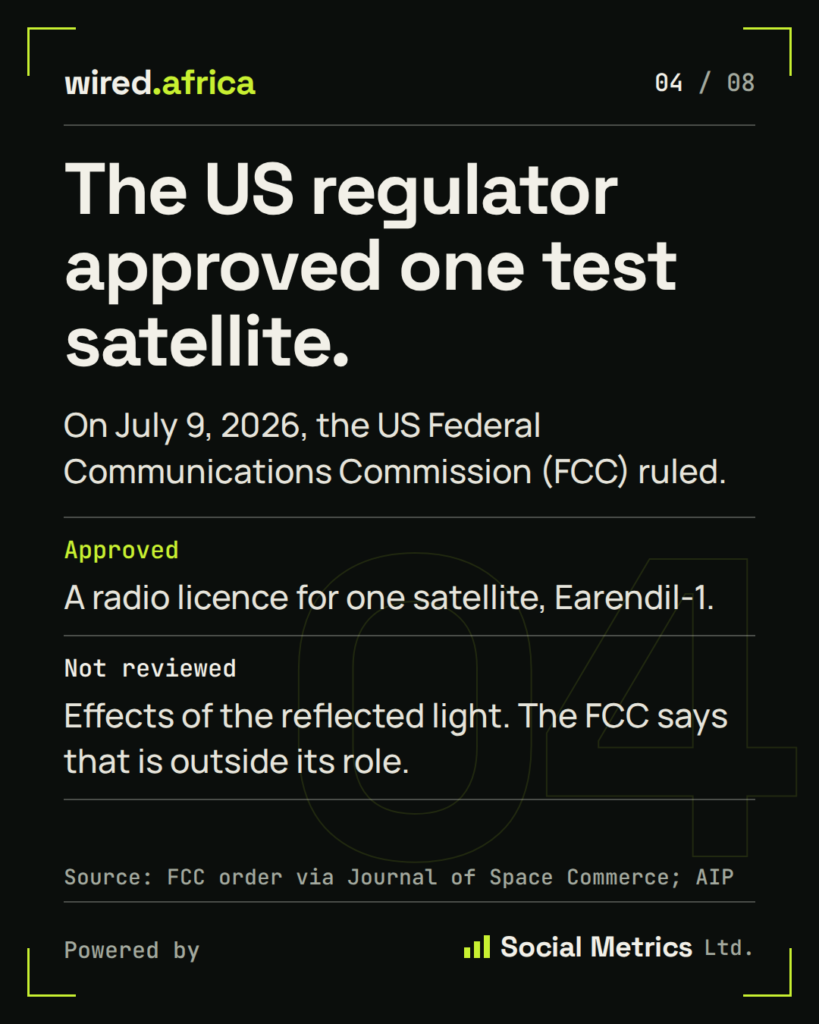
On July 9, 2026, the FCC’s Space Bureau granted Reflect Orbital authority to build, launch and operate Earendil-1, a single satellite. The grant covers radio frequencies in the S-, X- and UHF-bands (Journal of Space Commerce). The licence runs for two years (Astronomy magazine), and the FCC’s own order is public.
The reasoning matters. The FCC said the risks raised on the record were unrelated to its role in authorising radio spectrum use (The Conversation), and that the benefits of a limited, short test outweighed them (Newsweek). In plain terms, the FCC approved the satellite’s radio use. It did not assess the effects of the reflected light, which it said falls outside its authority (AIP).
The decision came over objections from the American Astronomical Society and other groups. DarkSky says the case drew more than 1,800 comments, the large majority opposed (DarkSky). Separately, the US National Oceanic and Atmospheric Administration (NOAA) has proposed a voluntary certification process for novel space activities that no other agency regulates, and says it would weigh effects on astronomy and light pollution (AIP).
The plan beyond the test
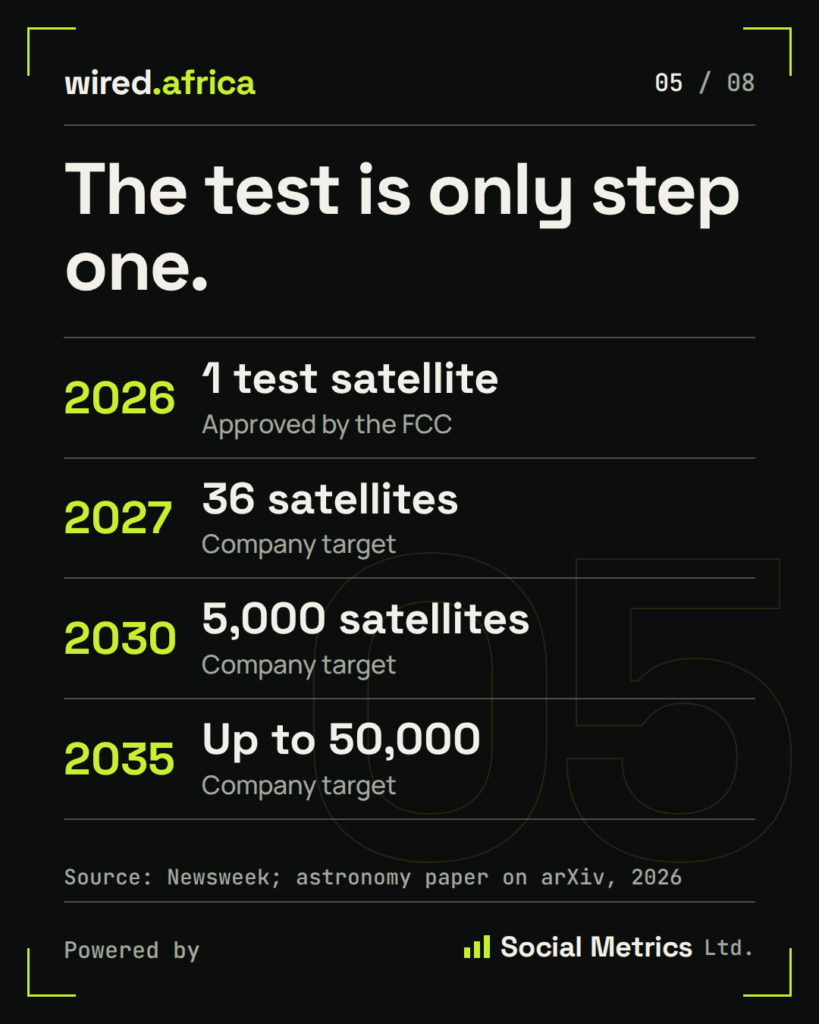
Earendil-1 is the first step in a much larger plan. Reflect Orbital has described a roadmap of 36 satellites in 2027, 5,000 by 2030 and up to 50,000 by 2035 (astronomy paper on arXiv). These are company targets, not approvals. The FCC order covers only Earendil-1.
For scale, astronomer Jonathan McDowell’s tracking shows about 16,200 active satellites in orbit as of September 9, 2026 (Jonathan’s Space Report). Fifty thousand mirror satellites would be roughly three times today’s entire working fleet.
In the near term, the company plans to launch three unfoldable test reflectors about three months apart, starting with Earendil-1. CEO Ben Nowack has said the first three would also earn revenue (Universe Today). A second prototype is planned by the end of the year, and Earendil-1 is designed to operate for about a year before being deorbited (Aerospace America).
Why scientists and conservation groups object
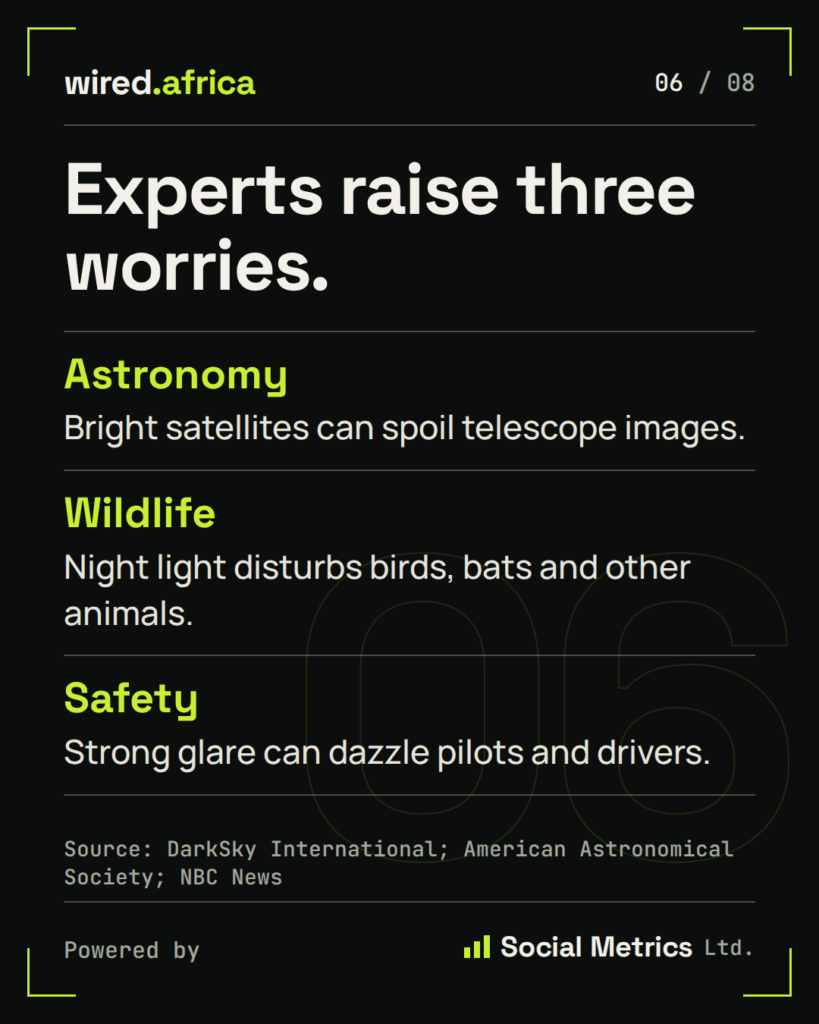
Astronomy. The American Astronomical Society told the FCC that even one satellite crossing a telescope’s field of view could saturate its detectors and cost observing time (DarkSky summary). The larger worry is scale. A 2026 astronomy paper modelled scattered light from constellations of 37, 5,000 and 50,000 extremely bright satellites.
Wildlife. DarkSky says roughly a third of vertebrates and most invertebrates are sensitive to night light, and that studies link artificial light to disrupted bird migration and changed breeding times (DarkSky). Its chief executive, Ruskin Hartley, told NBC that nobody knows exactly how a space mirror will affect animals because it has never been done (NBC News).
Eyes and safety. LED lighting expert Eric Bretschneider told NBC that focusing sunlight into a small, very bright point could create glare risks for pilots and drivers, comparing it to “a helicopter shining a spotlight right at you”. A DarkSky technical report goes further, saying the light could be intense enough to injure eyes faster than a person can blink (PEER release). That is the groups’ claim, and it has not been tested in orbit.
Sleep and body clocks. The presidents of four international societies for sleep and biological-rhythm research, representing about 2,500 researchers, wrote to US authorities about possible effects on human and animal body clocks (The Telegraph, via AOL).
What the company says. Reflect Orbital says it will use strict limits, independent review and public data (company statement). It says it is working on exclusion zones to protect observatories (AIP), and software meant to keep light away from dark-sky parks (Aerospace America).
The petition: what the groups want
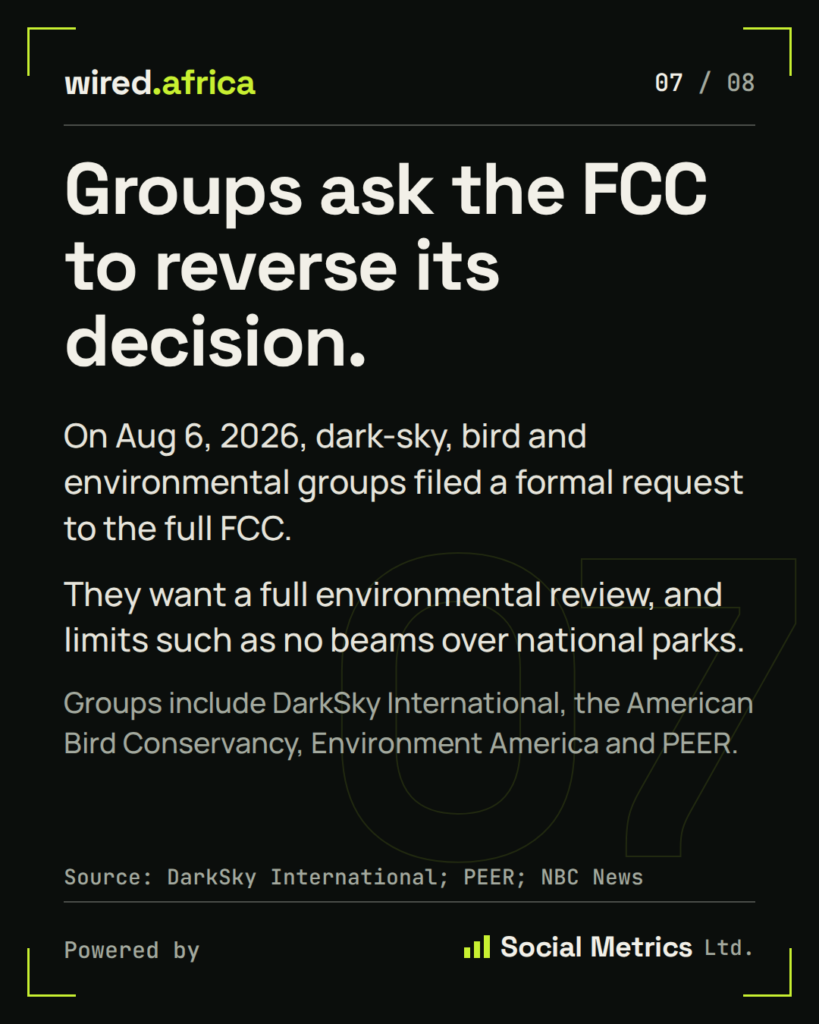
On August 6, 2026, DarkSky International, the American Bird Conservancy, Environment America and Public Employees for Environmental Responsibility (PEER), represented by Earthjustice, filed a formal Application for Review. It asks the full FCC to reverse the Space Bureau’s approval (DarkSky; PEER petition page).
They argue the FCC wrongly limited its review to radio interference and orbital debris, and skipped the environmental review normally required under the US National Environmental Policy Act. If the approval stands, they ask for 16 binding conditions, including:
- an independent analysis of scattered light and sky brightness;
- no beams over national parks, wildlife refuges and other protected land;
- pauses during peak bird migration and after midnight;
- sign-off from affected state, local and Tribal governments;
- independent verification of the actual beam (PEER release).
Reflect Orbital declined to comment on the petition when NBC asked (NBC News). At the time of writing we found no public ruling on it.
Can a space mirror really power solar farms at night?
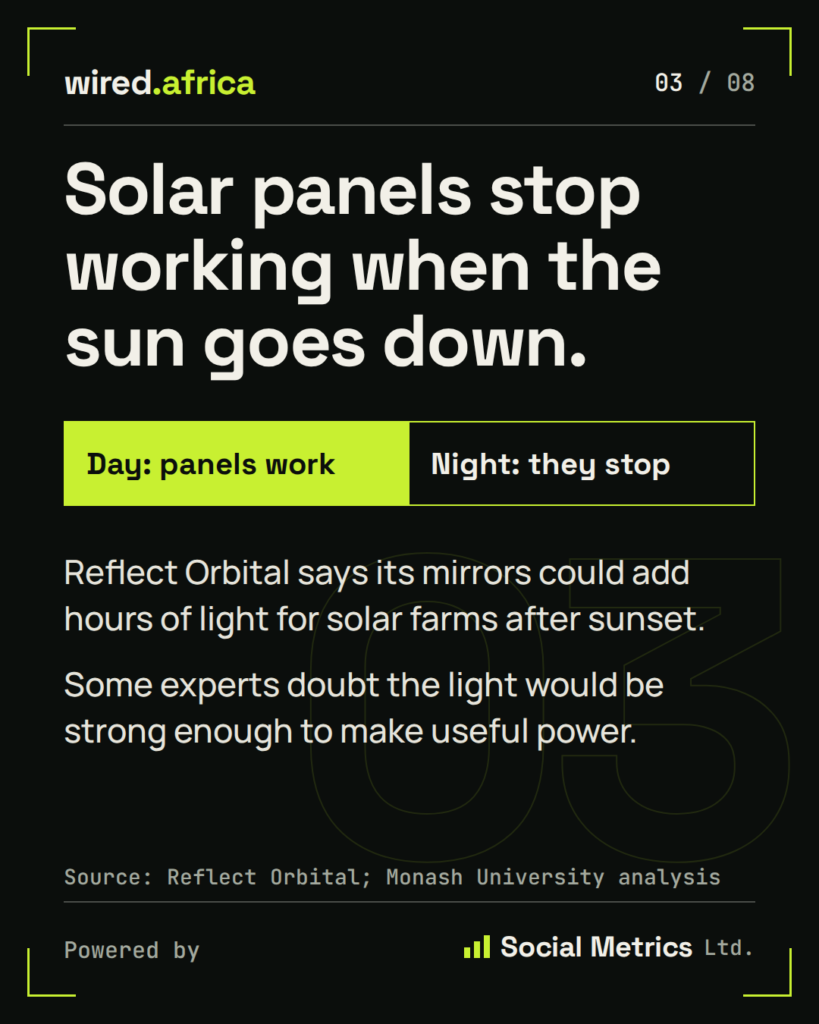
That is the company’s pitch. As ABC News (Australia) describes it, solar farms would pay to have sunlight pointed at their panels, as a partial alternative to battery storage. Independent experts are doubtful. A Monash University analysis concludes it is probably not a practical way to make affordable solar power at night, and Bretschneider told NBC that cloud cover would limit its usefulness.
The company describes Earendil-1 as a test-and-learn mission (ThomasNet). Light at full-moon strength is far weaker than midday sunlight, so this first mission is best read as a test of aiming and control rather than of power output.
It has been tried before
Space mirrors are not new. In 1993, a Russian team unfurled a mirror of more than 300 square metres from a cargo spacecraft and swept a beam about 4 km wide across Europe, brighter than the full moon (research roadmap on arXiv). What is new is the plan to operate them commercially, and at a far larger scale.
What to watch next
- The full FCC’s response to the August 6 petition.
- Earendil-1’s launch date and its first measured beams: how bright, how narrow, and how much light spreads beyond the target.
- Whether the US sets brightness rules or a review process for reflectors, including NOAA’s proposed certification.
- Whether the second prototype and the 2027 plan of 36 satellites keep to schedule.
Why this matters beyond the US
Solar plants everywhere face the same night-time gap, which is why storage and experiments like this one get attention. Satellites are already changing how people connect across the continent, and we cover that in our reporting on satellite internet in Africa. For the energy side, see our coverage of solar power in Africa, and follow our wider space technology reporting for updates on this story.
Frequently asked questions
What is Reflect Orbital?
Reflect Orbital is a California-based startup that wants to reflect sunlight from orbit onto specific places on Earth. Its first test satellite is Earendil-1.
Is the space mirror approved?
Only in part. The FCC approved a radio licence for one test satellite on July 9, 2026. It did not review the effects of the reflected light, and a challenge asking the full FCC to reverse the decision was filed on August 6, 2026.
When will Earendil-1 launch?
The company plans a launch later in 2026 but has not announced a date (Aerospace America).
Will it light up the whole night sky?
The beam is aimed at a spot about 3 miles wide. Critics say scattered light can extend beyond the target area (DarkSky), which is one reason they want independent testing.
Reporting for this article draws on Margherita Bassi’s August 13, 2026 report in Smithsonian Magazine, checked against the independent sources linked above. Last updated September 19, 2026.

The WIRED.Africa's Press Desk delivers breaking news, official announcements, and timely updates on technology, business, innovation, and digital policy. Stories published under this byline are produced through the collaborative efforts of the editorial team and trusted news sources.